Eisenkot says Israel in 'devastating diplomatic crisis' as he seeks to form govt
Why This Matters
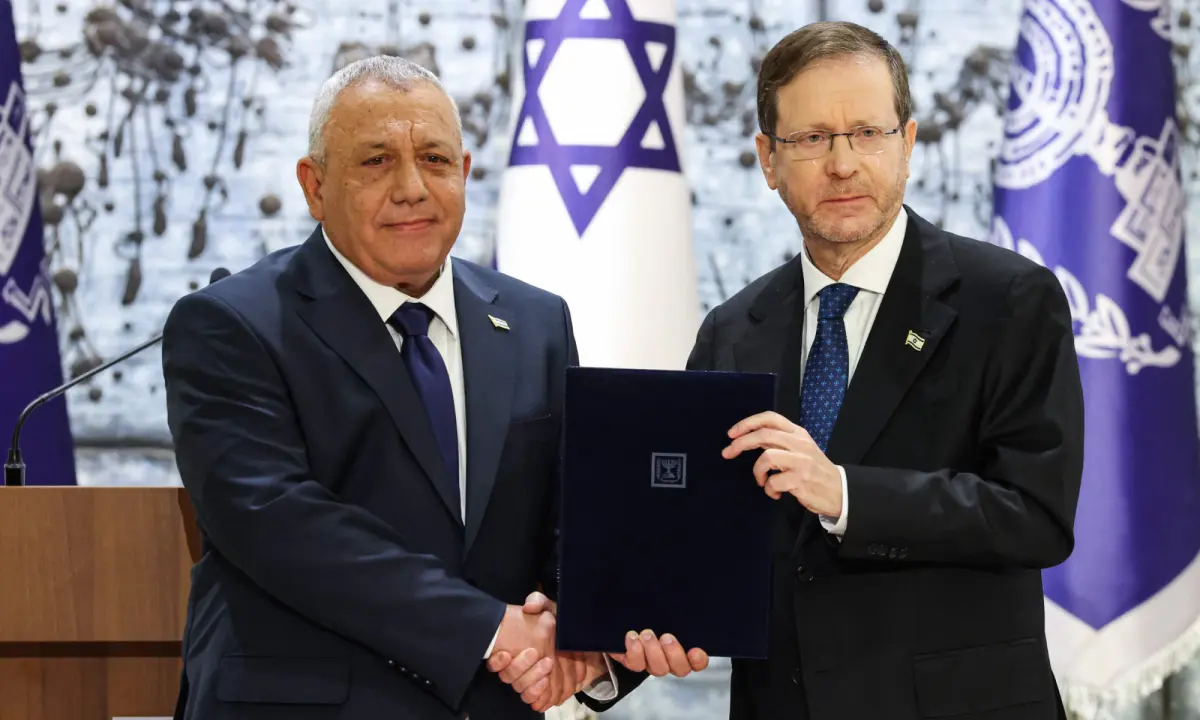
Key context: <p>Israel’s former military chief Gadi Eisenkot started the tough task on Sunday of forming a government, reaching out to Benjamin Netanyahu’s allies as he warned the veteran prime minister had brought the country to a historic crisis.</p> <p>Eisenkot, 66, a political novice who has vowed to bridge Israel’s deep polarisation under Netanyahu, formally received a <a href="https://www.dawn.com/news/2042866">mandate</a> from President Isaac Herzog, giving him 28 days to form a government despite his bloc lacking a clear majority.</p> <p>“We are in a state of emergency, approaching a point of no return for the State of Israel,” Eisenkot said at a ceremony at the presidential office.</p> <p>Both Eisenkot and Herzog acknowledged Israel’s <a href="https://www.dawn.com/news/1793515">growing isolation</a> under Netanyahu, who is <a href="https://www.dawn.com/news/1873877/icc-issues-arrest-warrants-for-israels-pm-netanyahu-gallant">wanted</a> by the International Criminal Court over allegations of crimes against humanity and war crimes in Gaza.</p> <figure class='media w-full sm:w-1/2 media--right media--embed media--uneven' data-original-src='https://www.dawn.com/news/2042215/analysis-midterms-clip-trumps-wings-at-home-not-abroad'> <div class='media__item media__item--newskitlink '> <iframe class="nk-iframe" width="100%" frameborder="0" scrolling="no" style="height:250px;position:relative" src="https://www.dawn.com/news/card/2042215" sandbox="allow-same-origin allow-scripts allow-popups allow-modals allow-forms"></iframe></div> </figure> <p>“We are in the midst of a devastating diplomatic crisis. Even our closest friends and strategic allies are saying their relationship with Israel must be reassessed,” Eisenkot said.</p> <p>“We must form a national emergency government. This will require creative and unconventional political steps,” Eisenkot stressed.</p> <p>He said Israeli democracy was at a vulnerable moment at a time when it faced immense challenges. “There is great urgency for new leadership, leadership that people can look in the eye and trust,” he said.</p> <figure class='media w-full w-full media-- media--embed media--uneven media--tweet' data-original-src='https://x.com/AJEnglish/status/2119464961353130283'> <div class='media__item media__item--twitter '><span> <blockquote class="twitter-tweet" lang="en"> <a href="https://twitter.com/AJEnglish/status/2119464961353130283"></a> </blockquote> </span></div> </figure> <p>Eisenkot appealed to Netanyahu’s Likud Party as well as the far-right party of Finance Minister Bezalel Smotrich to join — but only with himself as prime minister.</p> <p>“My door is open and my hand is extended, wholeheartedly and willingly, to anyone who understands the gravity of this moment,” he said.</p> <p>Meanwhile, Herzog cited a threat of attack from Iran, the need to progress towards peace in Gaza and negotiations with Lebanon and other neighbours.</p> <p>“We need to start shaping the political horizon in the region, and we also have to present the 20 points of the agreement in the Gaza strip, and consultations with our neighbours in Lebanon and the region,” he was quoted as saying in a translation by <em>Al Jazeera</em>.</p> <p>“We also have to deal with the sanctions and the political challenges in light of the recent political developments in the United States,” the Israeli president said.</p> <p>In the United States, the most vital ally of Israel, Democrats on Tuesday <a rel="noopener noreferrer" target="_blank" class="link--external" href="https://v">swept</a> the midterm elections with calls to rein in Israel after the devastation in Gaza and the unpopular Iran war which Netanyahu launched with President Donald Trump.</p> <figure class='media w-full w-full media-- media--embed media--uneven media--tweet' data-original-src='https://x.com/AJEnglish/status/2119453805469147343'> <div class='media__item media__item--twitter '><span> <blockquote class="twitter-tweet" lang="en"> <a href="https://twitter.com/AJEnglish/status/2119453805469147343"></a> </blockquote> </span></div> </figure> <p>Eisenkot, born to a family of working-class Moroccan immigrants, would be the first Sephardic prime minister — a community mostly descended from Middle Eastern or North African Jews — in a country long dominated by an Ashkenazi elite with ties to Europe.</p> <p>Netanyahu is Israel’s longest-serving prime minister, having led the country on and off for nearly two decades. He has taken the country in a sharply rightward direction and led wars against Gaza, Lebanon and Iran since the Oct 7, 2023 attacks by Hamas.</p> <p>Netanyahu called for a unity government of all Zionist parties to preserve a Jewish state, while giving no indication whether he was prepared to serve under Eisekenkot’s leadership.</p> <p>“This is the will of the people and the need of the hour,” he said in a statement, ruling out a coalition government with Arabs — who make up 21 per cent of Israel’s population.</p> <p>Nearly all Jewish parties now share Netanyahu’s rejection of an eventual independent Palestinian state, the basis of internationally endorsed peace efforts since the 1990s.</p> <h2><a id="negotiations-can-take-6-weeks" href="#negotiations-can-take-6-weeks" class="heading-permalink" aria-hidden="true" tabindex="-1" title="Permalink"></a>Negotiations can take 6 weeks</h2> <p>Eisenkot’s potential pathways to power include trying to form a minority government with Arab party support for key issues; forming a coalition with ultra-Orthodox parties that he and his allies have shunned in the past; or forging a unity government with Netanyahu. All three options face formidable obstacles.</p> <p>Eisenkot has appeared to suggest he is willing to start off with a minority government — relying on outside votes from Arab-Israeli parties — before bringing other lawmakers into his coalition.</p> <p>He said he will call on all parties to join who meet his main principles. These include recognition of Israel as a Jewish and democratic state; a duty of national service for all to strengthen the military and expand its ranks; and recognition of Hamas as a terrorist organisation and a commitment to destroying its military and governing capacity.</p> <p>“I am convinced that it is possible and right to form a new government quickly, one that will win a large majority in the Knesset,” Eisenkot said, referring to Israel’s parliament.</p> <p>Eisenkot now has 28 days plus a possible 14-day extension. If he fails, Netanyahu will likely get his shot at forming a government. Should he also be unable, new elections could be called.</p> <p>Assaf Shapira, a political expert at the Israel Democracy Institute, said Eisenkot would face an exceptionally fragile government if it only had 48 lawmakers in the 120-member parliament, with extensive negotiations needed on every piece of legislation.</p> <h2><a id="eisenkots-views" href="#eisenkots-views" class="heading-permalink" aria-hidden="true" tabindex="-1" title="Permalink"></a><strong>Eisenkot’s views</strong></h2> <p>Eisenkot has vowed to put an end to rampant violence against Palestinians by extremist West Bank settlers supported by Netanyahu’s government and has warned that the incumbent premier does not have the mandate for another attack on Iran.</p> <p>But he <a href="https://www.dawn.com/news/2042866#:~:text=How%20different%20are%20Eisenkot%E2%80%99s%20views%20from%20Netanyahu%3F">shares</a> Netanyahu’s hawkish security views that have hardened since Oct 7, 2023: he opposes Palestinian statehood and says Hamas’s military wing must be destroyed or dismantled.</p> <figure class='media w-full sm:w-1/2 media--right media--embed media--uneven' data-original-src='https://www.dawn.com/news/2038812/read-israels-election-may-change-its-leader-but-not-its-iran-war-policy'> <div class='media__item media__item--newskitlink '> <iframe class="nk-iframe" width="100%" frameborder="0" scrolling="no" style="height:250px;position:relative" src="https://www.dawn.com/news/card/2038812" sandbox="allow-same-origin allow-scripts allow-popups allow-modals allow-forms"></iframe></div> </figure> <p>He emphasised his security credentials on the campaign trail, citing his “<a rel="noopener noreferrer" target="_blank" class="link--external" href="https://www.washingtonpost.com/world/2023/11/10/israel-dahiya-doctrine-disproportionate-strategy-military-gaza-idf/"><u>Dahiya doctrine</u></a>” of responding to attacks with disproportionate force, which he deployed as a commander during Israel’s 2006 war with Hezbollah in Lebanon.</p> <p>Both Eisenkot and Netanyahu say Israeli troops will not withdraw from Gaza until Hamas is disarmed, and that Israel is prepared to restart fighting to achieve this.</p> <p>Although Eisenkot has criticised <a href="https://www.dawn.com/news/2033633"><u>settler violence</u></a> against Palestinians in occupied West Bank, which has surged since 2023, he favours settlement in principle and says it should comply with Israeli law.</p> <p>He opposes settlements built without authorisation, aims to dismantle outposts in areas where they are forbidden and has pledged to rein in violent settlers.</p> <h2><a id="wooing-the-ultra-orthodox" href="#wooing-the-ultra-orthodox" class="heading-permalink" aria-hidden="true" tabindex="-1" title="Permalink"></a>Wooing the ultra-Orthodox</h2> <p>In consultations last week with Herzog, Eisenkot <a href="https://www.dawn.com/news/2042866">received recommendations</a> from parties accounting for 67 lawmakers, against 46 for Netanyahu.</p> <p>But that vote count included Israeli Arabs, whose seat haul surged to a historic high on anger over Netanyahu’s government and whom several parties oppose having in government.</p> <p>Potentially making Eisenkot’s job tougher is the position of one opposition leader, Avigdor Lieberman of the Israel Our Home party, who has ruled out a unity government with Netanyahu or a minority government that has backing from Arab parties.</p> <p>Lieberman, a former Netanyahu aide turned sharp critic who nonetheless shares his hawkish views, has been adamant against any alliance with Arab Israelis, who are descendants of Palestinians who stayed after Israel’s creation in 1948.</p> <p>But Lieberman has softened his stance on sitting with ultra-Orthodox Jewish parties as long as they agree to support a law under which ultra-Orthodox men serve in the military.</p> <p>Taking back one of his signature campaign pledges, Lieberman instead voiced an openness to an alliance with ultra-Orthodox Jews, whose almost singular priority is ensuring that they remain exempt from military service.</p> <figure class='media w-full sm:w-1/2 media--right media--embed media--uneven' data-original-src='https://www.dawn.com/news/1952177/thousands-of-ultra-orthodox-jews-protest-israeli-military-service'> <div class='media__item media__item--newskitlink '> <iframe class="nk-iframe" width="100%" frameborder="0" scrolling="no" style="height:250px;position:relative" src="https://www.dawn.com/news/card/1952177" sandbox="allow-same-origin allow-scripts allow-popups allow-modals allow-forms"></iframe></div> </figure> <p>The <a rel="noopener noreferrer" target="_blank" class="link--external" href="https://v">exemption</a> for the ultra-Orthodox — whose two main parties had been aligned with Netanyahu but could push Eisenkot to a majority — has been a source of growing resentment for many Israelis as reservists fight on multiple tours of duty.</p> <p>Lieberman said on Sunday he still backed conscription for all Israelis but that he had to make “difficult decisions” for the higher priority of ousting Netanyahu, who faces corruption charges that could land him in jail if he loses power.</p> <p>Naftali Bennett, the second strongest opposition leader after Lieberman, has also been outspoken against the ultra-Orthodox community’s military exemption and has stayed quiet since Lieberman’s about-face.</p> <p>In Tel Aviv, Neri Bar-On, who works in educational technology, said he expected Eisenkot to succeed in forming a government.</p> <p>“But the problems run deeper,” he said.</p> <p>“The country is facing a massive internal conflict; even if he manages to form a government, it won’t solve the underlying issues.”</p> This development from dawn.com highlights ongoing changes in the sector.
Israel’s former military chief Gadi Eisenkot started the tough task on Sunday of forming a government, reaching out to Benjamin Netanyahu’s allies as he warned the veteran prime minister had brought the country to a historic crisis. Eisenkot, 66, a political novice who has vowed to bridge Israel’s deep polarisation under Netanyahu, formally received a mandate from President Isaac Herzog, giving him 28 days to form a government despite his bloc lacking a clear majority. “We are in a state of emergency, approaching a point of no return for the State of Israel,” Eisenkot said at a ceremony at the presidential office. Both Eisenkot and Herzog acknowledged Israel’s growing isolation under Netanyahu, who is wanted by the International Criminal Court over allegations of crimes against humanity and war crimes in Gaza. “We are in the midst of a devastating diplomatic crisis. Even our closest friends and strategic allies are saying their relationship with Israel must be reassessed,” Eisenkot said. “We must form a national emergency government. This will require creative and unconventional political steps,” Eisenkot stressed. He said Israeli democracy was at a vulnerable moment at a time when it faced immense challenges. “There is great urgency for new leadership, leadership that people can look in the eye and trust,” he said. Eisenkot appealed to Netanyahu’s Likud Party as well as the far-right party of Finance Minister Bezalel Smotrich to join — but only with himself as prime minister. “My door is open and my hand is extended, wholeheartedly and willingly, to anyone who understands the gravity of this moment,” he said. Meanwhile, Herzog cited a threat of attack from Iran, the need to progress towards peace in Gaza and negotiations with Lebanon and other neighbours. “We need to start shaping the political horizon in the region, and we also have to present the 20 points of the agreement in the Gaza strip, and consultations with our neighbours in Lebanon and the region,” he was quoted as saying in a translation by Al Jazeera. “We also have to deal with the sanctions and the political challenges in light of the recent political developments in the United States,” the Israeli president said. In the United States, the most vital ally of Israel, Democrats on Tuesday swept the midterm elections with calls to rein in Israel after the devastation in Gaza and the unpopular Iran war which Netanyahu launched with President Donald Trump. Eisenkot, born to a family of working-class Moroccan immigrants, would be the first Sephardic prime minister — a community mostly descended from Middle Eastern or North African Jews — in a country long dominated by an Ashkenazi elite with ties to Europe. Netanyahu is Israel’s longest-serving prime minister, having led the country on and off for nearly two decades. He has taken the country in a sharply rightward direction and led wars against Gaza, Lebanon and Iran since the Oct 7, 2023 attacks by Hamas. Netanyahu called for a unity government of all Zionist parties to preserve a Jewish state, while giving no indication whether he was prepared to serve under Eisekenkot’s leadership. “This is the will of the people and the need of the hour,” he said in a statement, ruling out a coalition government with Arabs — who make up 21 per cent of Israel’s population. Nearly all Jewish parties now share Netanyahu’s rejection of an eventual independent Palestinian state, the basis of internationally endorsed peace efforts since the 1990s. Negotiations can take 6 weeks Eisenkot’s potential pathways to power include trying to form a minority government with Arab party support for key issues; forming a coalition with ultra-Orthodox parties that he and his allies have shunned in the past; or forging a unity government with Netanyahu. All three options face formidable obstacles. Eisenkot has appeared to suggest he is willing to start off with a minority government — relying on outside votes from Arab-Israeli parties — before bringing other lawmakers into his coalition. He said he will call on all parties to join who meet his main principles. These include recognition of Israel as a Jewish and democratic state; a duty of national service for all to strengthen the military and expand its ranks; and recognition of Hamas as a terrorist organisation and a commitment to destroying its military and governing capacity. “I am convinced that it is possible and right to form a new government quickly, one that will win a large majority in the Knesset,” Eisenkot said, referring to Israel’s parliament. Eisenkot now has 28 days plus a possible 14-day extension. If he fails, Netanyahu will likely get his shot at forming a government. Should he also be unable, new elections could be called. Assaf Shapira, a political expert at the Israel Democracy Institute, said Eisenkot would face an exceptionally fragile government if it only had 48 lawmakers in the 120-member parliament, with extensive negotiations needed on every piece of legislation. Eisenkot’s views Eisenkot has vowed to put an end to rampant violence against Palestinians by extremist West Bank settlers supported by Netanyahu’s government and has warned that the incumbent premier does not have the mandate for another attack on Iran. But he shares Netanyahu’s hawkish security views that have hardened since Oct 7, 2023: he opposes Palestinian statehood and says Hamas’s military wing must be destroyed or dismantled. He emphasised his security credentials on the campaign trail, citing his “Dahiya doctrine” of responding to attacks with disproportionate force, which he deployed as a commander during Israel’s 2006 war with Hezbollah in Lebanon. Both Eisenkot and Netanyahu say Israeli troops will not withdraw from Gaza until Hamas is disarmed, and that Israel is prepared to restart fighting to achieve this. Although Eisenkot has criticised settler violence against Palestinians in occupied West Bank, which has surged since 2023, he favours settlement in principle and says it should comply with Israeli law. He opposes settlements built without authorisation, aims to dismantle outposts in areas where they are forbidden and has pledged to rein in violent settlers. Wooing the ultra-Orthodox In consultations last week with Herzog, Eisenkot received recommendations from parties accounting for 67 lawmakers, against 46 for Netanyahu. But that vote count included Israeli Arabs, whose seat haul surged to a historic high on anger over Netanyahu’s government and whom several parties oppose having in government. Potentially making Eisenkot’s job tougher is the position of one opposition leader, Avigdor Lieberman of the Israel Our Home party, who has ruled out a unity government with Netanyahu or a minority government that has backing from Arab parties. Lieberman, a former Netanyahu aide turned sharp critic who nonetheless shares his hawkish views, has been adamant against any alliance with Arab Israelis, who are descendants of Palestinians who stayed after Israel’s creation in 1948. But Lieberman has softened his stance on sitting with ultra-Orthodox Jewish parties as long as they agree to support a law under which ultra-Orthodox men serve in the military. Taking back one of his signature campaign pledges, Lieberman instead voiced an openness to an alliance with ultra-Orthodox Jews, whose almost singular priority is ensuring that they remain exempt from military service. The exemption for the ultra-Orthodox — whose two main parties had been aligned with Netanyahu but could push Eisenkot to a majority — has been a source of growing resentment for many Israelis as reservists fight on multiple tours of duty. Lieberman said on Sunday he still backed conscription for all Israelis but that he had to make “difficult decisions” for the higher priority of ousting Netanyahu, who faces corruption charges that could land him in jail if he loses power. Naftali Bennett, the second strongest opposition leader after Lieberman, has also been outspoken against the ultra-Orthodox community’s military exemption and has stayed quiet since Lieberman’s about-face. In Tel Aviv, Neri Bar-On, who works in educational technology, said he expected Eisenkot to succeed in forming a government. “But the problems run deeper,” he said. “The country is facing a massive internal conflict; even if he manages to form a government, it won’t solve the underlying issues.”
Curation & Context
This page summarizes a public news report from dawn.com. Global News Hub provides the "Why This Matters" takeaway using editorial insights and AI curation to give readers rapid, high-value context before they click through to read the full article.