No, a strike on Iran’s nukes can’t cook Pakistan, Afghanistan
Why This Matters
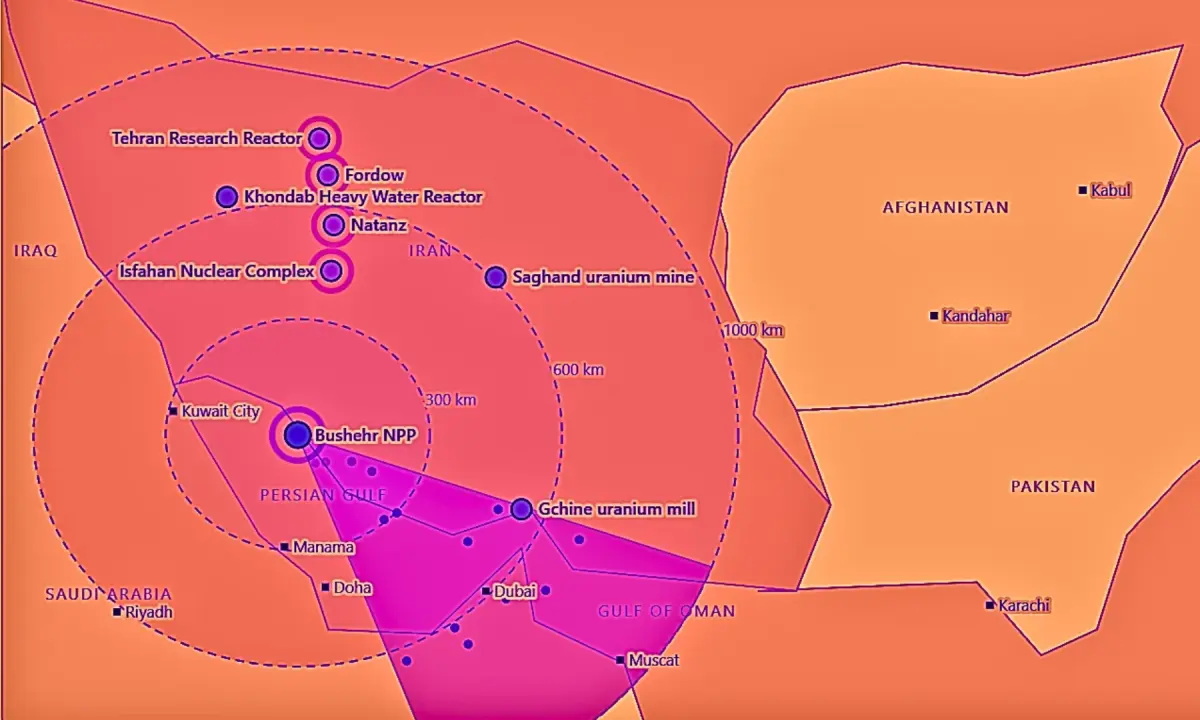
Key context: <p>A hysterical map on social media instead has cooked up an image of the blast radius of radioactive fallout if Iran’s nuclear facilities were attacked. It fancies that it shows how radiation would reach Khyber Pakhtunkhwa and Balochistan, parts of Afghanistan, and potentially other areas depending on atmospheric conditions.</p> <p>The map is based on the claim that: ‘Pakistan and Afghanistan would be blanketed by the fallout of radiation if nuclear facilities in Iran are attacked.’ Such a broad conclusion reflects an incomplete understanding of the nature of Iran’s nuclear facilities as well as the geographical and metrological factors that would determine the potential consequences of any military strike. It should, therefore, be approached with caution and supported by a rigorous, evidence-based assessment instead of being presented as an inevitable outcome.</p> <p>In our view, this claim has been presented without real data, supporting facts, calculations, or illustrations of a plausible scenario or a string of scenarios resulting from any such attack of this nature. For it to be credible, certain assumptions would need to be established under two possibilities: an attack on facilities carrying fission fragments and irradiated fuel and, an attack on facilities carrying natural uranium, enriched uranium, heavy water, mining and milling facilities, research reactors etc. Then these two possibilities should be considered with the choice and the nature of the attacks if carried out by the United States and its allies. Let us examine two possible scenarios; in one conventional weapons are used and in the other nuclear weapons are used to attack Iran’s facilities.</p> <div class="raw-html-embed-wrapper" style="width: 100%;"> <script type="text/plain" class="raw-html-source"> <!DOCTYPE html> <html lang="en"><head><meta charset="utf-8"> <meta name="viewport" content="width=device-width, initial-scale=1, viewport-fit=cover"> <title>Iran Nuclear Sites & Fallout Scenario Map</title> <style> :root{--bg:#f7f6f2;--card:#fff;--tx:#1d1d1b;--mut:#6b6a64;--sea:#cfe3ee;--land:#ece8da;--ir:#e3d9bd;--ln:#9a947f;--red:#c0392b;--amb:#d98a00;--gry:#7d7d78;--bd:#d9d6c9;--box:padding-top} :root{color-scheme:light dark;box-sizing:border-box;padding-top:env(safe-area-inset-top,0px);padding-bottom:env(safe-area-inset-bottom,0px)} @media (prefers-color-scheme:dark){:root:not([data-theme="light"]){--bg:#17181a;--card:#222426;--tx:#ececE8;--mut:#a3a29b;--sea:#1d2d38;--land:#2c2e2b;--ir:#3b3a31;--ln:#6d6b5e;--bd:#3a3c3e;--amb:#f0a830;--red:#ee6a5a}} *{box-sizing:border-box}body{margin:0;background:var(--bg);color:var(--tx);font:15px/1.5 system-ui,-apple-system,"Segoe UI",sans-serif} .w{max-width:1000px;margin:0 auto;padding:14px} h1{font-size:20px;margin:0 0 2px}.sub{color:var(--mut);font-size:13px;margin:0 0 12px} .ctl{display:flex;flex-wrap:wrap;gap:8px 16px;background:var(--card);border:1px solid var(--bd);border-radius:10px;padding:10px 12px;margin-bottom:10px;font-size:13px;align-items:center} .ctl label{display:flex;align-items:center;gap:5px}select,input[type=range]{font:inherit} select{background:var(--bg);color:var(--tx);border:1px solid var(--bd);border-radius:6px;padding:2px 4px} .map{background:var(--sea);border:1px solid var(--bd);border-radius:10px;overflow:hidden} svg{display:block;width:100%;height:auto} .fac{cursor:pointer}.fac:focus{outline:none}.fac:focus circle,.fac:hover circle{stroke-width:3} .info{background:var(--card);border:1px solid var(--bd);border-radius:10px;padding:12px 14px;margin-top:10px;min-height:96px} .info h2{font-size:16px;margin:0 0 4px}.tag{display:inline-block;font-size:11px;padding:1px 8px;border-radius:99px;color:#fff;margin-bottom:4px} .leg{display:flex;flex-wrap:wrap;gap:6px 14px;font-size:12px;color:var(--mut);margin-top:8px} .leg i{display:inline-block;width:10px;height:10px;border-radius:50%;margin-right:4px} .note{font-size:12px;color:var(--mut);margin-top:8px} text{font-family:inherit} .lb{paint-order:stroke;stroke:var(--sea);stroke-width:4px;stroke-linejoin:round} .map.big{overflow-x:auto;-webkit-overflow-scrolling:touch}.map.big svg{width:1100px;max-width:none} @media (max-width:600px){.w{padding:8px}h1{font-size:18px}.ctl{gap:6px 12px;padding:8px}.ctl label{min-height:30px}input[type=range]{width:100%}button{padding:8px 12px}.info{padding:10px}} .pulse{transform-box:fill-box;transform-origin:center;animation:pl 2s ease-out infinite}.pulse.hit{animation-duration:.8s} @keyframes pl{0%{transform:scale(1);opacity:.9}100%{transform:scale(2.8);opacity:0}} .shock{transform-box:fill-box;transform-origin:center;opacity:0;animation:sh 1.8s ease-out forwards} @keyframes sh{0%{transform:scale(.1);opacity:.9}100%{transform:scale(1);opacity:0}} button{font:inherit;background:var(--red);color:#fff;border:0;border-radius:6px;padding:4px 12px;cursor:pointer}button.alt{background:var(--bg);color:var(--tx);border:1px solid var(--bd)}button:disabled{opacity:.5;cursor:default} @media (prefers-reduced-motion:reduce){.pulse,.shock{animation:none}} </style></head><body><div class="w"> <h1>Iran Nuclear Sites: Strike & Fallout Scenarios</h1> <p class="sub">Schematic scenario map. Click a site for details; adjust the controls to explore fallout reach.</p> <div class="ctl"> <label><input type="checkbox" id="cRings" checked> Bushehr fallout rings</label> <label><input type="checkbox" id="cPlume" checked> Wind plume</label> <label><input type="checkbox" id="cWind" checked> Animate wind</label> <button id="bStrike">💥 Simulate strike on selected site</button><button id="bReset" class="alt">Reset</button> <label>Wind toward <select id="wind"><option value="135">South-east (Gulf / Oman)</option><option value="180">South (Saudi / Qatar / UAE)</option><option value="225">South-west (Saudi Arabia)</option><option value="90">East (Pakistan)</option><option value="45">North-east (Afghanistan)</option></select></label> <label>Reach <input type="range" id="rad" min="100" max="1000" step="50" value="1000"> <b id="rv">1000 km</b></label> <label><input type="checkbox" id="cNon" checked> Non-fissile sites</label> <label><input type="checkbox" id="cLab" checked> Site labels</label> <label><input type="checkbox" id="cCit" checked> City labels</label> <button id="bBig" class="alt">Larger map</button> </div> <div class="map"><svg id="svg" viewBox="0 0 840 540" role="img" aria-label="Map of Iran nuclear sites and fallout scenarios"></svg></div> <div class="leg"><span><i style="background:var(--red)"></i>Operating reactor (largest fallout potential)</span><span><i style="background:var(--amb)"></i>Fissile material / status uncertain</span><span><i style="background:var(--gry)"></i>No fissile inventory (negligible fallout)</span></div> <div class="info" id="info"><h2>Select a site</h2><div>Click any marker to see its status and fallout relevance. Cities inside the active fallout reach are listed when Bushehr is selected.</div></div> <p class="note">Schematic only: simplified borders, equirectangular projection, circles are idealised distance rings, not dispersion forecasts. Site statuses reflect the scenario text supplied by the author and are unverified. Real plumes depend on weather, release height and source term; use official monitoring (IAEA, CTBTO, national agencies) for actual data.</p> </div> <script> const X=lo=>(lo-44)*30,Y=la=>(40-la)*30; const poly=(p,c,s)=>`<polygon points="${p.map(q=>X(q[0]).toFixed(1)+','+Y(q[1]).toFixed(1)).join(' ')}" fill="${c}" stroke="var(--ln)" stroke-width="1" ${s||''}/>`; const IR=[[44,39.4],[48,38.4],[49,37.6],[53,36.9],[54,37.4],[56,38],[60,36.6],[61,35.6],[60.8,34.5],[60.5,33],[61.2,31.4],[61.8,30.8],[61.5,29.3],[63.3,27.2],[62.5,25.2],[57.3,25.7],[56.3,27.1],[54.5,26.5],[52,27.5],[50.5,29.5],[48.8,30.2],[48,30],[47.7,31],[46,33],[45.5,34.5],[44.8,36.5],[44.2,38.2]]; const AF=[[61.2,35.6],[62.3,36.9],[65,37.5],[67.8,37.2],[70,37.6],[71.5,37.9],[71,36.5],[71.5,35.6],[71,34.2],[69.5,31.5],[66.5,29.8],[64.5,29.5],[62.5,29.4],[61.7,30.8],[60.8,31.5],[60.9,33.5],[60.6,34.5]]; const PK=[[62.5,29.4],[64.5,29.5],[66.5,29.8],[69.5,31.5],[71,34.2],[71.6,35.5],[74,37],[75.5,36.5],[74.5,34.5],[74.2,32.5],[75,31.2],[74,30],[71.5,27.9],[70.2,26.5],[69.5,24.3],[68.2,23.7],[66.7,25.4],[64,25.3],[61.6,25.2],[62.5,25.2],[63.3,27.2]]; const AR=[[44,22],[59,22],[58.5,23.5],[56.4,24.5],[56.1,26.2],[54,24.2],[51.6,24.3],[51.2,25.5],[50,26.5],[48.5,29],[48,30],[47.7,31],[46,33],[45.5,34.5],[44.8,36.5],[44,37]]; const F=[ {id:'n',n:'Natanz',la:33.72,lo:51.73,c:'amb',t:'Principal industrial enrichment complex',d:'Underground and above-ground halls. Above-ground structures reported destroyed after US strikes. The quantity and enrichment level of any material remaining underground is unknown. Fallout risk is mainly local and chemical/radiological rather than long-range.'}, {id:'f',n:'Fordow',la:34.88,lo:51.59,c:'amb',t:'Underground enrichment facility near Qom',d:'Built inside a mountain. Reportedly struck repeatedly, but the US claim of destruction is not independently confirmed. No confirmed expanding radiation plume; this could be checked by independent monitoring.'}, {id:'i',n:'Isfahan Nuclear Complex',la:32.65,lo:51.67,c:'amb',t:'Uranium conversion and fuel fabrication',d:'Converts and fabricates uranium fuel. Material stocks and damage status are unclear. Hazard is mostly local contamination.'}, {id:'b',n:'Bushehr NPP',la:28.83,lo:50.89,c:'red',t:'Commercial VVER-1000 MW reactor',d:'The only operating power reactor. In this scenario, a strike could spread fallout across the Gulf, including Saudi Arabia and other Gulf states and the US bases there, not only Pakistan or Afghanistan. Chernobyl showed contamination with highly variable patterns detected beyond 1,000 km.'}, {id:'t',n:'Tehran Research Reactor',la:35.73,lo:51.39,c:'amb',t:'5 MW research reactor, 20% enriched fuel',d:'Small research reactor with limited inventory. Dense urban surroundings raise local exposure concerns, but far smaller long-range potential than a power reactor.'}, {id:'k',n:'Khondab Heavy Water Reactor',la:34.37,lo:49.24,c:'gry',t:'Heavy water facility (Arak)',d:'Not a facility carrying fissionable material in this scenario; negligible fallout potential.',non:1}, {id:'m1',n:'Saghand uranium mine',la:32.5,lo:55.5,c:'gry',t:'Uranium mining / processing',d:'Mining and ore processing; non-fissile in terms of radiation fallout.',non:1}, {id:'m2',n:'Gchine uranium mill',la:27.1,lo:56.1,c:'gry',t:'Uranium mining / processing',d:'Mining and ore processing; non-fissile in terms of radiation fallout.',non:1}]; const C=[['Karachi',24.86,67.01],['Kabul',34.53,69.17],['Riyadh',24.71,46.68],['Doha',25.29,51.53],['Dubai',25.2,55.27],['Kuwait City',29.38,47.99],['Manama',26.23,50.58],['Muscat',23.59,58.4],['Kandahar',31.61,65.71],['Islamabad',33.68,73.05]]; const km=(a,b,c,d)=>{const r=Math.PI/180,x=Math.sin((c-a)*r/2)**2+Math.cos(a*r)*Math.cos(c*r)*Math.sin((d-b)*r/2)**2;return 12742*Math.asin(Math.sqrt(x))}; const B=F.find(f=>f.id==='b'),$=i=>document.getElementById(i); function pt(la,lo,k,br){const r=br*Math.PI/180;return [lo+k*Math.sin(r)/(111.3*Math.cos(la*Math.PI/180)),la+k*Math.cos(r)/111.3]} function draw(){ const R=+$('rad').value;$('rv').textContent=R+' km';const W=$('svg').clientWidth||840,K=Math.max(1,Math.min(2.4,840/W)); let s=`<rect width="840" height="540" fill="var(--sea)"/>`+poly(AR,'var(--land)')+poly(AF,'var(--land)')+poly(PK,'var(--land)')+poly(IR,'var(--ir)'); [['IRAN',X(54),Y(33)],['AFGHANISTAN',X(66),Y(34)],['PAKISTAN',X(68.5),Y(27.5)],['SAUDI ARABIA',X(46.5),Y(25)],['IRAQ',X(44.8),Y(33)],['PERSIAN GULF',X(51.5),Y(27.3)],['GULF OF OMAN',X(59.5),Y(24.6)]].forEach(t=>s+=`<text x="${t[1]}" y="${t[2]}" text-anchor="middle" font-size="${11*K}" letter-spacing="1.5" fill="var(--mut)" opacity=".8">${t[0]}</text>`); const bx=X(B.lo),by=Y(B.la); if($('cRings').checked)[300,600,1000].filter(k=>k<=R+0.1||k===1000&&R>=1000).forEach(k=>{if(k>R&&k!==Math.min(1000,R))return;s+=`<ellipse cx="${bx}" cy="${by}" rx="${k/(111.3*Math.cos(B.la*Math.PI/180))*30}" ry="${k/111.3*30}" fill="var(--red)" fill-opacity=".05" stroke="var(--red)" stroke-dasharray="6 4" stroke-width="1.2"/><text class="lb" x="${bx+k/(111.3*Math.cos(B.la*Math.PI/180))*30*.966}" y="${by-k/111.3*30*.259}" font-size="${11*K}" fill="var(--red)">${k} km</text>`}); if($('cRings').checked&&R<300)s+=`<ellipse cx="${bx}" cy="${by}" rx="${R/(111.3*Math.cos(B.la*Math.PI/180))*30}" ry="${R/111.3*30}" fill="var(--red)" fill-opacity=".08" stroke="var(--red)" stroke-dasharray="6 4"/>`; if($('cPlume').checked){const w=+$('wind').value,p=[[B.lo,B.la]];for(let a=-25;a<=25;a+=5)p.push(pt(B.la,B.lo,R,w+a));s+=poly(p,'var(--red)','fill-opacity=".28" stroke="var(--red)"'); if($('cWind').checked&&!RM)for(let i=0;i<16;i++){const a=w-22+(i%8)*6.3,e=pt(B.la,B.lo,R,a),d=(3+(i%4)*.8).toFixed(1);s+=`<circle r="${3.2*K}" fill="var(--red)"><animateMotion dur="${d}s" begin="-${(i*.45).toFixed(2)}s" repeatCount="indefinite" path="M${bx},${by} L${X(e[0]).toFixed(1)},${Y(e[1]).toFixed(1)}"/><animate attributeName="opacity" values="0;.9;.9;0" dur="${d}s" begin="-${(i*.45).toFixed(2)}s" repeatCount="indefinite"/></circle>`}} C.forEach(c=>{const x=X(c[2]),y=Y(c[1]);if(!$('cCit').checked)return;s+=`<rect x="${x-2.5*K}" y="${y-2.5*K}" width="${5*K}" height="${5*K}" fill="var(--tx)"/><text class="lb" x="${x+6*K}" y="${y+4*K}" font-size="${11*K}" fill="var(--tx)">${c[0]}</text>`}); F.forEach(f=>{if(f.non&&!$('cNon').checked)return;const M=1+(K-1)*.6,showLab=$('cLab').checked||cur===f.id,x=X(f.lo),y=Y(f.la),col=`var(--${f.c})`; s+=`<g class="fac" tabindex="0" role="button" aria-label="${f.n}" data-id="${f.id}">${f.c==='gry'&&!struck.has(f.id)?'':`<circle class="pulse${struck.has(f.id)?' hit':''}" cx="${x}" cy="${y}" r="${(f.id==='b'?9:7)*M}" fill="none" stroke="${struck.has(f.id)?'var(--red)':col}" stroke-width="2"/>`}<circle cx="${x}" cy="${y}" r="${(f.id==='b'?9:7)*M}" fill="${col}" stroke="var(--tx)" stroke-width="1.5"/>${showLab?`<text class="lb" x="${x+(['t','i'].includes(f.id)?-12*M:12*M)}" y="${y+4*K}" text-anchor="${['t','i'].includes(f.id)?'end':'start'}" font-size="${12*K}" font-weight="600" fill="var(--tx)">${f.n}</text>`:''}<circle cx="${x}" cy="${y}" r="${18*M}" fill="transparent"/></g>`}); s+='<g id="fx"></g>';$('svg').innerHTML=s; document.querySelectorAll('.fac').forEach(g=>{const go=()=>{show(g.dataset.id);if(!$('cLab').checked)draw()};g.onclick=go;g.onkeydown=e=>{if(e.key==='Enter'||e.key===' ')go()}}); } let cur=null;const struck=new Set(),RM=matchMedia('(prefers-reduced-motion:reduce)').matches; function strike(){const id=cur||'b',f=F.find(q=>q.id===id),tx=X(f.lo),ty=Y(f.la),fx=$('fx'),sx=tx-240,sy=-20,ang=Math.atan2(ty-sy,tx-sx)*180/Math.PI+90,btn=$('bStrike'),T=RM?1:1500,t0=performance.now(); btn.disabled=true;show(id); fx.innerHTML=`<line id="tr" x1="${sx}" y1="${sy}" x2="${sx}" y2="${sy}" stroke="var(--amb)" stroke-width="2" stroke-dasharray="4 3"/><g id="ms"><polygon points="0,-10 4,6 0,3 -4,6" fill="var(--tx)" stroke="var(--red)"/><circle r="3" cy="9" fill="var(--amb)"/></g>`; const ms=$('ms'),tr=$('tr'); (function step(now){const k=Math.min(1,(now-t0)/T),e=k*k,x=sx+(tx-sx)*e,y=sy+(ty-sy)*e;ms.setAttribute('transform',`translate(${x},${y}) rotate(${ang})`);tr.setAttribute('x2',x);tr.setAttribute('y2',y); if(k<1)return requestAnimationFrame(step); const R0=id==='b'?110:60;fx.innerHTML=`<circle cx="${tx}" cy="${ty}" r="22" fill="#fff" class="shock" style="animation-duration:.5s"/>`+[0,.35,.7].map(d=>`<circle cx="${tx}" cy="${ty}" r="${R0}" fill="none" stroke="var(--red)" stroke-width="3" class="shock" style="animation-delay:${d}s"/>`).join(''); struck.add(id);if(id==='b'){$('cPlume').checked=true;$('cRings').checked=true} setTimeout(()=>{draw();show(id);btn.disabled=false},1900)})(t0);} $('bStrike').onclick=strike;$('bReset').onclick=()=>{struck.clear();draw();if(cur)show(cur)}; function show(id){cur=id;const f=F.find(q=>q.id===id),lab={red:'Operating reactor',amb:'Uncertain inventory',gry:'No fissile inventory'}[f.c]; let h=`<span class="tag" style="background:var(--${f.c})">${lab}</span><h2>${f.n}</h2><div><b>${f.t}.</b> ${f.d}</div>`; if(id==='b'){const R=+$('rad').value,l=C.map(c=>[c[0],km(B.la,B.lo,c[1],c[2])]).filter(c=>c[1]<=R).sort((a,b)=>a[1]-b[1]); h+=`<div style="margin-top:6px"><b>Cities within ${R} km:</b> ${l.length?l.map(c=>c[0]+' ('+Math.round(c[1])+' km)').join(', '):'none'}</div>`;} $('info').innerHTML=h;if(innerWidth<700)$('info').scrollIntoView({block:'nearest',behavior:'smooth'})} if(innerWidth<600){$('cLab').checked=false;$('cCit').checked=false} $('bBig').onclick=()=>{const m=document.querySelector('.map'),b=m.classList.toggle('big');$('bBig').textContent=b?'Fit to screen':'Larger map';draw()}; let rz;addEventListener('resize',()=>{clearTimeout(rz);rz=setTimeout(draw,150)}); ['cRings','cPlume','cWind','wind','rad','cNon','cLab','cCit'].forEach(i=>$(i).addEventListener('input',()=>{draw();if(cur==='b')show('b')})); draw(); <\/script></body></html></script> <script> (function () { var me = document.currentScript || document.scripts[document.scripts.length - 1]; var wrapper = me && me.closest('.raw-html-embed-wrapper'); var source = wrapper && wrapper.querySelector('script.raw-html-source'); if (!source || wrapper._rawHtmlMounted) return; wrapper._rawHtmlMounted = true; // position:sticky breaks under any overflow:hidden ancestor. "clip" hides the same overflow // without creating a scroll container. for (var a = wrapper.parentElement; a; a = a.parentElement) { var cs = getComputedStyle(a); if (cs.overflowX === 'hidden') a.style.overflowX = 'clip'; if (cs.overflowY === 'hidden') a.style.overflowY = 'clip'; } // Undo the server-side escaping of closing script tags / comment openers. var html = source.textContent.replace(/<(\\+)(\/script|!--)/gi, function (m, slashes, token) { return '<' + slashes.slice(1) + token; }); source.remove(); // iOS Safari kills tabs that hold many large base64 images: turn them into blob: URLs. // blob: URLs work inside the srcdoc frame because it inherits our origin. html = html.replace(/data:(image\/[\w.+-]+);base64,([A-Za-z0-9+\/=]+)/g, function (m, type, b64) { if (b64.length < 4096) return m; try { var bin = atob(b64), bytes = new Uint8Array(bin.length); for (var i = 0; i < bin.length; i++) bytes[i] = bin.charCodeAt(i); return URL.createObjectURL(new Blob([bytes], { type: type })); } catch (e) { return m; } }); var track = document.createElement('div'); var stage = document.createElement('div'); var frame = document.createElement('iframe'); track.style.cssText = 'position:relative;width:100%'; frame.style.cssText = 'display:block;width:100%;height:100%;border:0'; frame.title = 'Interactive embed'; frame.setAttribute('scrolling', 'no'); // must be set before insertion frame.srcdoc = html; var win = null, doc = null; var pinned = false; // true: content is taller than the screen, so it scrolls with the page var max = 0; // furthest the embedded document can scroll var fitH = 0; // height of the frame when not pinned var last = -1; function fillScreen(el) { el.style.height = '100vh'; el.style.height = '100svh'; // ignored by browsers without svh (keeps 100vh) } // Copy the page scroll into the embedded document. 'instant' because AI pages often set // scroll-behavior:smooth, which would make the copy lag. function sync(force) { if (!win) return; var y = Math.min(Math.max(-track.getBoundingClientRect().top, 0), max); if (force || y !== last) { last = y; win.scrollTo({ top: y, left: 0, behavior: 'instant' }); } } function measure() { if (!win) return; var root = doc.documentElement; var scroller = doc.scrollingElement || root; // scrollHeight is floored at the frame height, so it is only the true content height once // the content overflows the frame. Otherwise use the root element's own box. var h = Math.ceil(scroller.scrollHeight > frame.clientHeight ? scroller.scrollHeight : root.getBoundingClientRect().height); pinned = h > window.innerHeight; if (pinned) { stage.style.position = 'sticky'; stage.style.top = '0'; fillScreen(stage); track.style.height = h + 'px'; max = Math.max(0, h - frame.clientHeight); } else { // Grow only: vh-based content would otherwise shrink with its own frame, forever. fitH = Math.max(fitH, h); stage.style.position = 'static'; stage.style.height = fitH + 'px'; track.style.height = 'auto'; max = 0; } sync(true); } // <a href="#x"> inside the frame would only scroll the (non-scrollable) frame. Scroll the page instead. function onAnchorClick(e) { var link = e.target.closest && e.target.closest('a[href^="#"]'); if (!link || e.defaultPrevented) return; var id = link.getAttribute('href').slice(1); try { id = decodeURIComponent(id); } catch (x) { } var target = id ? doc.getElementById(id) : null; if (id && !target) return; e.preventDefault(); var inFrame = target ? target.getBoundingClientRect().top + win.scrollY : 0; window.scrollTo({ top: track.getBoundingClientRect().top + window.scrollY + (pinned ? Math.min(inFrame, max) : inFrame), behavior: 'smooth' }); } frame.addEventListener('load', function () { try { win = frame.contentWindow; doc = win.document; var ro = new win.ResizeObserver(measure); // created in the frame's realm ro.observe(doc.documentElement); if (doc.body) ro.observe(doc.body); doc.addEventListener('click', onAnchorClick); measure(); } catch (e) { // No script access to the frame: fall back to a plain scrollable frame. win = null; frame.removeAttribute('scrolling'); stage.style.position = 'static'; fillScreen(stage); track.style.height = 'auto'; } }); fillScreen(stage); fillScreen(track); // placeholder until the frame has loaded and been measured window.addEventListener('scroll', function () { sync(false); }, { passive: true }); window.addEventListener('resize', measure); stage.appendChild(frame); track.appendChild(stage); wrapper.appendChild(track); })(); </script> </div> <h2><a id="what-are-irans-facilities" href="#what-are-irans-facilities" class="heading-permalink" aria-hidden="true" tabindex="-1" title="Permalink"></a><strong>What are Iran’s facilities</strong></h2> <p><strong>Natanz</strong> is the principal industrial uranium enrichment complex with underground and above-ground infrastructure. <br><em>It has been hit by the US and its above-ground structures have been destroyed. The underground allegedly fissionable material is still unknown in quantity and enrichment capacity</em>.</p> <p><strong>Fordow</strong> is an underground uranium enrichment facility near Qum, recognized as an advanced enrichment installation located within a mountain complex. <br><em>The facility has reportedly been struck repeatedly, however, no definitive confirmation has emerged regarding the American claim that it was destroyed, or that radiation plumes are expanding</em>.</p> <p>The <strong>Isfahan Nuclear Complex</strong> is a uranium conversion and nuclear fuel fabrication facility.</p> <p>The <strong>Bushehr Nuclear Power Plant</strong> is a commercial VVER-1000 MW pressurized water reactor. <br><em>A possible fallout if the attack is not restricted to Pakistan or Afghanistan, but will cover the entire Gulf region, including Saudi Arabia. The consequences would be similar to that of Chernobyl which demonstrated that radioactive fallout with highly variable contamination can be detected more than 1000km away. American bases and its allies can also suffer.</em></p> <p>The <strong>Tehran Research Complex</strong> is a 5MW research reactor that uses 20% enriched uranium as fuel.</p> <p>The <strong>Khondab Heavy Water Reactor</strong> is not a facility carrying fissionable materials.</p> <p>The uranium mining and processing facilities are non-fissionable material facilities in terms of radiation fallouts.</p> <p>Iran also possesses supporting facilities for nuclear research, centrifuge manufacturing, hot cells, and other related activities. But they cannot be considered facilities carrying fissionable materials that can lead to radiation fallouts that could reach Pakistan or Afghanistan.</p> <p>The American and Israeli military attacks in June 2025 affected several major Iranian nuclear facilities. Therefore, the list above should not be interpreted as a confirmation that all these installations are currently operational.</p> <p>These facilities do not present the same radiological hazards as operating nuclear power plants. Nevertheless, an assessment of the consequences of the previous attacks indicates that significant radioactive fallout was not detected beyond the affected facilities.</p> <p>Similarly, an attack on Natanz and Fordow would not necessarily result in significant radiological releases into the wider environment because uranium and enriched uranium, although radioactive, do not contain the substantial inventory of fission products found in irradiated reactor fuel.</p> <p>Significant contamination within a damaged enrichment facility is possible. However, a major radiological release affecting Saudi Arabia, Kuwait, Bahrain, Qatar, or the UAE should not be considered a reasonable default assumption.</p> <p>The IAEA watchdog has already stated that following the June 2025 attacks, radiation levels outside the affected facilities remained normal. Therefore, claims regarding radiological consequences for neighbouring countries should not be based on unsupported assumptions.</p> <p>The situation would be considerably different in the case of a nuclear power plant operating along the Persian Gulf coast. If such a facility were struck by conventional weapons, the potential consequences could be more serious because it contains substantial quantities of radioactive fission products and irradiated nuclear fuel.</p> <p>Its geographical location, together with prevailing wind patterns, could also contribute to a wider radiological exposure and fallout pattern than would be expected from attacks on inland Iranian facilities, many of which are deeply buried or constructed with protective infrastructure in accordance with the safety requirements applicable to civilian nuclear installations.</p> <p>A severe accident involving damage to the reactor core, loss of cooling, or failure of safety barriers could release radioactive material. However, a projectile striking a nuclear power plant does not automatically mean that sufficient radioactive material will be released into the environment to cause a major radiological accident.</p> <p>The consequences would depend on whether the reactor, its safety systems, cooling systems, and supporting infrastructure were damaged, as well as the extent of that damage. Furthermore, attacks on civilian nuclear power plants raise serious issues under international humanitarian law and applicable international conventions, including the Convention on the Physical Protection of Nuclear Material and Nuclear Facilities (as amended by the 2005 Amendment), 1977 Additional Protocol to the Geneva Convention etc.</p> <p>Any assessment of such an attack must also take into account whether the nuclear power plant is operational at the time of the strike. The most significant question is what military purpose will the United States gain from attacking a nuclear power plant which has been under the IAEA safeguards for decades and is not reported for any diversion of. nuclear materials from the facility.</p> <p>Other nuclear facilities, including research reactors, fuel fabrication plants, uranium conversion facilities, and radioactive material storage locations, may also present some risk of radiological releases. However, these risks are considerably smaller than those associated with a large operating nuclear power plant in terms of radiation fallouts or contamination zones.</p> <p>The overall assessment of the potential consequences for each facility is as follows:</p> <p><strong>Natanz / Fordow enrichment plants</strong>: Low radiological consequences beyond the immediate facility, with no reasonable basis for assuming a significant radiological threat to neighboring countries.</p> <p><strong>Isfahan conversion/fuel facilities</strong>: Primarily localized chemical and radiological hazards are expected.</p> <p><strong>Research reactors</strong>: Potential radiological consequences that would generally be expected to remain within a limited geographical area, potentially extending a few kilometers from the facility, depending on the nature and severity of the incident.</p> <p><strong>Bushehr Nuclear Power Plant</strong> and spent fuel storage: Potentially serious transboundary radiological consequences in the event of a severe accident, although such an outcome is not inevitable and would depend on the nature and extent of the damage.</p> <h2><a id="what-if-you-go-nuclear" href="#what-if-you-go-nuclear" class="heading-permalink" aria-hidden="true" tabindex="-1" title="Permalink"></a><strong>What if you go nuclear?</strong></h2> <p>Another scenario sometimes discussed is the possibility of using nuclear weapons against Iran or its nuclear facilities. This remains highly speculative and extremely unlikely. Nuclear weapons have been used in warfare only once, in 1945, when the United States dropped atomic bombs on Hiroshima and Nagasaki. Since then, despite numerous international conflicts, severe geopolitical crises, and periods of heightened nuclear tensions, no country has resorted to using nuclear weapons in an armed conflict. This restraint reflects the understanding of not only the devastating humanitarian and environmental consequences of their use but also the far-reaching strategic, political, and international repercussions that would inevitably follow.</p> <p>Most importantly, the use of nuclear weapons would not necessarily translate into a military victory for the United States. On the contrary, it could result in a complete loss of control over the Strait of Hormuz as the region may not approve of such an action. Already the US has achieved successful engagement of its military targets at the very onset of the war. And lastly Bushrer does not qualify as a significant military target. Iran’s demonstrated resilience in maintaining its political and military structures during and after the initial strikes against its leadership and strategic installations indicates that the projection of a decisive military victory cannot be sustained unilaterally. Any eventual political settlement would still require the acceptance of the Iranian leadership, which may not be forthcoming.</p> <p>The use of nuclear weapons against Iran would cross an exceptionally dangerous threshold. It would fundamentally alter the international security environment, undermine the longstanding norm against nuclear weapons use, and potentially trigger unpredictable regional and global consequences. The country responsible could face enormous international condemnation, diplomatic isolation, and potentially severe strategic repercussions. This would be an extremely difficult and potentially self-defeating course of action, particularly when a range of conventional military, diplomatic, economic, and other alternatives remain available. Why would any country deliberately do this when the consequences could extend far beyond the immediate conflict and potentially shape international security for generations to come?</p> <p>In our assessment, the use of nuclear weapons should therefore be treated as an extreme hypothetical scenario rather than a realistic expectation in the context of the current confrontation.</p> <ul> <li> <p>It is scientifically inappropriate to assume that damage to Iranian uranium enrichment and nuclear fuel-cycle facilities would necessarily expose neighbouring countries to significant levels of radiation.</p> </li> <li> <p>Serious questions can be raised about American professor, Robert A. Pape’s <a rel="noopener noreferrer" target="_blank" class="link--external" href="https://substack.com/home/post/p-223246569"><u>warning that Pakistan and Afghanistan would inevitably face severe radiological consequences</u></a> (<a rel="noopener noreferrer" target="_blank" class="link--external" href="https://www.youtube.com/shorts/vvwVvxJ0UXE"><u>watch this influencer’s Urdu commentary</u></a>). Such an assessment would require a detailed understanding of the specific facility targeted, its operational status, the radioactive inventory involved, the nature and extent of the damage, and the prevailing meteorological conditions and also the war outcome.</p> </li> <li> <p>Significant transboundary radiological fallout cannot simply be presumed; it would require a credible scientific assessment supported by facility-specific data and atmospheric dispersion modelling.</p> </li> <li> <p>A deep understanding is needed of the war objectives of the United States whether they can be achieved by the use of nuclear weapons. The same is true for Israeli military planners as well, except in this case the Iranian ability to respond would perhaps create a new phase of a war cycle which would not be as controllable as believed.</p> </li> <li> <p>A nuclear war is too serious a business to be left for the arbitrary conclusions where it can affect the future of mankind itself.<br></p> </li> </ul> This development from dawn.com highlights ongoing changes in the sector.
A hysterical map on social media instead has cooked up an image of the blast radius of radioactive fallout if Iran’s nuclear facilities were attacked. It fancies that it shows how radiation would reach Khyber Pakhtunkhwa and Balochistan, parts of Afghanistan, and potentially other areas depending on atmospheric conditions. The map is based on the claim that: ‘Pakistan and Afghanistan would be blanketed by the fallout of radiation if nuclear facilities in Iran are attacked.’ Such a broad conclusion reflects an incomplete understanding of the nature of Iran’s nuclear facilities as well as the geographical and metrological factors that would determine the potential consequences of any military strike. It should, therefore, be approached with caution and supported by a rigorous, evidence-based assessment instead of being presented as an inevitable outcome. In our view, this claim has been presented without real data, supporting facts, calculations, or illustrations of a plausible scenario or a string of scenarios resulting from any such attack of this nature. For it to be credible, certain assumptions would need to be established under two possibilities: an attack on facilities carrying fission fragments and irradiated fuel and, an attack on facilities carrying natural uranium, enriched uranium, heavy water, mining and milling facilities, research reactors etc. Then these two possibilities should be considered with the choice and the nature of the attacks if carried out by the United States and its allies. Let us examine two possible scenarios; in one conventional weapons are used and in the other nuclear weapons are used to attack Iran’s facilities. Iran Nuclear Sites & Fallout Scenario Map :root{--bg:#f7f6f2;--card:#fff;--tx:#1d1d1b;--mut:#6b6a64;--sea:#cfe3ee;--land:#ece8da;--ir:#e3d9bd;--ln:#9a947f;--red:#c0392b;--amb:#d98a00;--gry:#7d7d78;--bd:#d9d6c9;--box:padding-top} :root{color-scheme:light dark;box-sizing:border-box;padding-top:env(safe-area-inset-top,0px);padding-bottom:env(safe-area-inset-bottom,0px)} @media (prefers-color-scheme:dark){:root:not([data-theme="light"]){--bg:#17181a;--card:#222426;--tx:#ececE8;--mut:#a3a29b;--sea:#1d2d38;--land:#2c2e2b;--ir:#3b3a31;--ln:#6d6b5e;--bd:#3a3c3e;--amb:#f0a830;--red:#ee6a5a}} *{box-sizing:border-box}body{margin:0;background:var(--bg);color:var(--tx);font:15px/1.5 system-ui,-apple-system,"Segoe UI",sans-serif} .w{max-width:1000px;margin:0 auto;padding:14px} h1{font-size:20px;margin:0 0 2px}.sub{color:var(--mut);font-size:13px;margin:0 0 12px} .ctl{display:flex;flex-wrap:wrap;gap:8px 16px;background:var(--card);border:1px solid var(--bd);border-radius:10px;padding:10px 12px;margin-bottom:10px;font-size:13px;align-items:center} .ctl label{display:flex;align-items:center;gap:5px}select,input[type=range]{font:inherit} select{background:var(--bg);color:var(--tx);border:1px solid var(--bd);border-radius:6px;padding:2px 4px} .map{background:var(--sea);border:1px solid var(--bd);border-radius:10px;overflow:hidden} svg{display:block;width:100%;height:auto} .fac{cursor:pointer}.fac:focus{outline:none}.fac:focus circle,.fac:hover circle{stroke-width:3} .info{background:var(--card);border:1px solid var(--bd);border-radius:10px;padding:12px 14px;margin-top:10px;min-height:96px} .info h2{font-size:16px;margin:0 0 4px}.tag{display:inline-block;font-size:11px;padding:1px 8px;border-radius:99px;color:#fff;margin-bottom:4px} .leg{display:flex;flex-wrap:wrap;gap:6px 14px;font-size:12px;color:var(--mut);margin-top:8px} .leg i{display:inline-block;width:10px;height:10px;border-radius:50%;margin-right:4px} .note{font-size:12px;color:var(--mut);margin-top:8px} text{font-family:inherit} .lb{paint-order:stroke;stroke:var(--sea);stroke-width:4px;stroke-linejoin:round} .map.big{overflow-x:auto;-webkit-overflow-scrolling:touch}.map.big svg{width:1100px;max-width:none} @media (max-width:600px){.w{padding:8px}h1{font-size:18px}.ctl{gap:6px 12px;padding:8px}.ctl label{min-height:30px}input[type=range]{width:100%}button{padding:8px 12px}.info{padding:10px}} .pulse{transform-box:fill-box;transform-origin:center;animation:pl 2s ease-out infinite}.pulse.hit{animation-duration:.8s} @keyframes pl{0%{transform:scale(1);opacity:.9}100%{transform:scale(2.8);opacity:0}} .shock{transform-box:fill-box;transform-origin:center;opacity:0;animation:sh 1.8s ease-out forwards} @keyframes sh{0%{transform:scale(.1);opacity:.9}100%{transform:scale(1);opacity:0}} button{font:inherit;background:var(--red);color:#fff;border:0;border-radius:6px;padding:4px 12px;cursor:pointer}button.alt{background:var(--bg);color:var(--tx);border:1px solid var(--bd)}button:disabled{opacity:.5;cursor:default} @media (prefers-reduced-motion:reduce){.pulse,.shock{animation:none}} Iran Nuclear Sites: Strike & Fallout Scenarios Schematic scenario map. Click a site for details; adjust the controls to explore fallout reach. Bushehr fallout rings Wind plume Animate wind 💥 Simulate strike on selected siteReset Wind toward South-east (Gulf / Oman)South (Saudi / Qatar / UAE)South-west (Saudi Arabia)East (Pakistan)North-east (Afghanistan) Reach 1000 km Non-fissile sites Site labels City labels Larger map Operating reactor (largest fallout potential)Fissile material / status uncertainNo fissile inventory (negligible fallout) Select a siteClick any marker to see its status and fallout relevance. Cities inside the active fallout reach are listed when Bushehr is selected. Schematic only: simplified borders, equirectangular projection, circles are idealised distance rings, not dispersion forecasts. Site statuses reflect the scenario text supplied by the author and are unverified. Real plumes depend on weather, release height and source term; use official monitoring (IAEA, CTBTO, national agencies) for actual data. const X=lo=>(lo-44)*30,Y=la=>(40-la)*30; const poly=(p,c,s)=>`X(q[0]).toFixed(1)+','+Y(q[1]).toFixed(1)).join(' ')}" fill="${c}" stroke="var(--ln)" stroke-width="1" ${s||''}/>`; const IR=[[44,39.4],[48,38.4],[49,37.6],[53,36.9],[54,37.4],[56,38],[60,36.6],[61,35.6],[60.8,34.5],[60.5,33],[61.2,31.4],[61.8,30.8],[61.5,29.3],[63.3,27.2],[62.5,25.2],[57.3,25.7],[56.3,27.1],[54.5,26.5],[52,27.5],[50.5,29.5],[48.8,30.2],[48,30],[47.7,31],[46,33],[45.5,34.5],[44.8,36.5],[44.2,38.2]]; const AF=[[61.2,35.6],[62.3,36.9],[65,37.5],[67.8,37.2],[70,37.6],[71.5,37.9],[71,36.5],[71.5,35.6],[71,34.2],[69.5,31.5],[66.5,29.8],[64.5,29.5],[62.5,29.4],[61.7,30.8],[60.8,31.5],[60.9,33.5],[60.6,34.5]]; const PK=[[62.5,29.4],[64.5,29.5],[66.5,29.8],[69.5,31.5],[71,34.2],[71.6,35.5],[74,37],[75.5,36.5],[74.5,34.5],[74.2,32.5],[75,31.2],[74,30],[71.5,27.9],[70.2,26.5],[69.5,24.3],[68.2,23.7],[66.7,25.4],[64,25.3],[61.6,25.2],[62.5,25.2],[63.3,27.2]]; const AR=[[44,22],[59,22],[58.5,23.5],[56.4,24.5],[56.1,26.2],[54,24.2],[51.6,24.3],[51.2,25.5],[50,26.5],[48.5,29],[48,30],[47.7,31],[46,33],[45.5,34.5],[44.8,36.5],[44,37]]; const F=[ {id:'n',n:'Natanz',la:33.72,lo:51.73,c:'amb',t:'Principal industrial enrichment complex',d:'Underground and above-ground halls. Above-ground structures reported destroyed after US strikes. The quantity and enrichment level of any material remaining underground is unknown. Fallout risk is mainly local and chemical/radiological rather than long-range.'}, {id:'f',n:'Fordow',la:34.88,lo:51.59,c:'amb',t:'Underground enrichment facility near Qom',d:'Built inside a mountain. Reportedly struck repeatedly, but the US claim of destruction is not independently confirmed. No confirmed expanding radiation plume; this could be checked by independent monitoring.'}, {id:'i',n:'Isfahan Nuclear Complex',la:32.65,lo:51.67,c:'amb',t:'Uranium conversion and fuel fabrication',d:'Converts and fabricates uranium fuel. Material stocks and damage status are unclear. Hazard is mostly local contamination.'}, {id:'b',n:'Bushehr NPP',la:28.83,lo:50.89,c:'red',t:'Commercial VVER-1000 MW reactor',d:'The only operating power reactor. In this scenario, a strike could spread fallout across the Gulf, including Saudi Arabia and other Gulf states and the US bases there, not only Pakistan or Afghanistan. Chernobyl showed contamination with highly variable patterns detected beyond 1,000 km.'}, {id:'t',n:'Tehran Research Reactor',la:35.73,lo:51.39,c:'amb',t:'5 MW research reactor, 20% enriched fuel',d:'Small research reactor with limited inventory. Dense urban surroundings raise local exposure concerns, but far smaller long-range potential than a power reactor.'}, {id:'k',n:'Khondab Heavy Water Reactor',la:34.37,lo:49.24,c:'gry',t:'Heavy water facility (Arak)',d:'Not a facility carrying fissionable material in this scenario; negligible fallout potential.',non:1}, {id:'m1',n:'Saghand uranium mine',la:32.5,lo:55.5,c:'gry',t:'Uranium mining / processing',d:'Mining and ore processing; non-fissile in terms of radiation fallout.',non:1}, {id:'m2',n:'Gchine uranium mill',la:27.1,lo:56.1,c:'gry',t:'Uranium mining / processing',d:'Mining and ore processing; non-fissile in terms of radiation fallout.',non:1}]; const C=[['Karachi',24.86,67.01],['Kabul',34.53,69.17],['Riyadh',24.71,46.68],['Doha',25.29,51.53],['Dubai',25.2,55.27],['Kuwait City',29.38,47.99],['Manama',26.23,50.58],['Muscat',23.59,58.4],['Kandahar',31.61,65.71],['Islamabad',33.68,73.05]]; const km=(a,b,c,d)=>{const r=Math.PI/180,x=Math.sin((c-a)*r/2)**2+Math.cos(a*r)*Math.cos(c*r)*Math.sin((d-b)*r/2)**2;return 12742*Math.asin(Math.sqrt(x))}; const B=F.find(f=>f.id==='b'),$=i=>document.getElementById(i); function pt(la,lo,k,br){const r=br*Math.PI/180;return [lo+k*Math.sin(r)/(111.3*Math.cos(la*Math.PI/180)),la+k*Math.cos(r)/111.3]} function draw(){ const R=+$('rad').value;$('rv').textContent=R+' km';const W=$('svg').clientWidth||840,K=Math.max(1,Math.min(2.4,840/W)); let s=``+poly(AR,'var(--land)')+poly(AF,'var(--land)')+poly(PK,'var(--land)')+poly(IR,'var(--ir)'); [['IRAN',X(54),Y(33)],['AFGHANISTAN',X(66),Y(34)],['PAKISTAN',X(68.5),Y(27.5)],['SAUDI ARABIA',X(46.5),Y(25)],['IRAQ',X(44.8),Y(33)],['PERSIAN GULF',X(51.5),Y(27.3)],['GULF OF OMAN',X(59.5),Y(24.6)]].forEach(t=>s+=`${t[0]}`); const bx=X(B.lo),by=Y(B.la); if($('cRings').checked)[300,600,1000].filter(k=>k=1000).forEach(k=>{if(k>R&&k!==Math.min(1000,R))return;s+=`${k} km`}); if($('cRings').checked&&R`; if($('cPlume').checked){const w=+$('wind').value,p=[[B.lo,B.la]];for(let a=-25;a`}} C.forEach(c=>{const x=X(c[2]),y=Y(c[1]);if(!$('cCit').checked)return;s+=`${c[0]}`}); F.forEach(f=>{if(f.non&&!$('cNon').checked)return;const M=1+(K-1)*.6,showLab=$('cLab').checked||cur===f.id,x=X(f.lo),y=Y(f.la),col=`var(--${f.c})`; s+=`${f.c==='gry'&&!struck.has(f.id)?'':``}${showLab?`${f.n}`:''}`}); s+='';$('svg').innerHTML=s; document.querySelectorAll('.fac').forEach(g=>{const go=()=>{show(g.dataset.id);if(!$('cLab').checked)draw()};g.onclick=go;g.onkeydown=e=>{if(e.key==='Enter'||e.key===' ')go()}}); } let cur=null;const struck=new Set(),RM=matchMedia('(prefers-reduced-motion:reduce)').matches; function strike(){const id=cur||'b',f=F.find(q=>q.id===id),tx=X(f.lo),ty=Y(f.la),fx=$('fx'),sx=tx-240,sy=-20,ang=Math.atan2(ty-sy,tx-sx)*180/Math.PI+90,btn=$('bStrike'),T=RM?1:1500,t0=performance.now(); btn.disabled=true;show(id); fx.innerHTML=``; const ms=$('ms'),tr=$('tr'); (function step(now){const k=Math.min(1,(now-t0)/T),e=k*k,x=sx+(tx-sx)*e,y=sy+(ty-sy)*e;ms.setAttribute('transform',`translate(${x},${y}) rotate(${ang})`);tr.setAttribute('x2',x);tr.setAttribute('y2',y); if(k`+[0,.35,.7].map(d=>``).join(''); struck.add(id);if(id==='b'){$('cPlume').checked=true;$('cRings').checked=true} setTimeout(()=>{draw();show(id);btn.disabled=false},1900)})(t0);} $('bStrike').onclick=strike;$('bReset').onclick=()=>{struck.clear();draw();if(cur)show(cur)}; function show(id){cur=id;const f=F.find(q=>q.id===id),lab={red:'Operating reactor',amb:'Uncertain inventory',gry:'No fissile inventory'}[f.c]; let h=`${lab}${f.n}${f.t}. ${f.d}`; if(id==='b'){const R=+$('rad').value,l=C.map(c=>[c[0],km(B.la,B.lo,c[1],c[2])]).filter(c=>c[1]a[1]-b[1]); h+=`Cities within ${R} km: ${l.length?l.map(c=>c[0]+' ('+Math.round(c[1])+' km)').join(', '):'none'}`;} $('info').innerHTML=h;if(innerWidth{const m=document.querySelector('.map'),b=m.classList.toggle('big');$('bBig').textContent=b?'Fit to screen':'Larger map';draw()}; let rz;addEventListener('resize',()=>{clearTimeout(rz);rz=setTimeout(draw,150)}); ['cRings','cPlume','cWind','wind','rad','cNon','cLab','cCit'].forEach(i=>$(i).addEventListener('input',()=>{draw();if(cur==='b')show('b')})); draw(); (function () { var me = document.currentScript || document.scripts[document.scripts.length - 1]; var wrapper = me && me.closest('.raw-html-embed-wrapper'); var source = wrapper && wrapper.querySelector('script.raw-html-source'); if (!source || wrapper._rawHtmlMounted) return; wrapper._rawHtmlMounted = true; // position:sticky breaks under any overflow:hidden ancestor. "clip" hides the same overflow // without creating a scroll container. for (var a = wrapper.parentElement; a; a = a.parentElement) { var cs = getComputedStyle(a); if (cs.overflowX === 'hidden') a.style.overflowX = 'clip'; if (cs.overflowY === 'hidden') a.style.overflowY = 'clip'; } // Undo the server-side escaping of closing script tags / comment openers. var html = source.textContent.replace(/ frame.clientHeight ? scroller.scrollHeight : root.getBoundingClientRect().height); pinned = h > window.innerHeight; if (pinned) { stage.style.position = 'sticky'; stage.style.top = '0'; fillScreen(stage); track.style.height = h + 'px'; max = Math.max(0, h - frame.clientHeight); } else { // Grow only: vh-based content would otherwise shrink with its own frame, forever. fitH = Math.max(fitH, h); stage.style.position = 'static'; stage.style.height = fitH + 'px'; track.style.height = 'auto'; max = 0; } sync(true); } // inside the frame would only scroll the (non-scrollable) frame. Scroll the page instead. function onAnchorClick(e) { var link = e.target.closest && e.target.closest('a[href^="#"]'); if (!link || e.defaultPrevented) return; var id = link.getAttribute('href').slice(1); try { id = decodeURIComponent(id); } catch (x) { } var target = id ? doc.getElementById(id) : null; if (id && !target) return; e.preventDefault(); var inFrame = target ? target.getBoundingClientRect().top + win.scrollY : 0; window.scrollTo({ top: track.getBoundingClientRect().top + window.scrollY + (pinned ? Math.min(inFrame, max) : inFrame), behavior: 'smooth' }); } frame.addEventListener('load', function () { try { win = frame.contentWindow; doc = win.document; var ro = new win.ResizeObserver(measure); // created in the frame's realm ro.observe(doc.documentElement); if (doc.body) ro.observe(doc.body); doc.addEventListener('click', onAnchorClick); measure(); } catch (e) { // No script access to the frame: fall back to a plain scrollable frame. win = null; frame.removeAttribute('scrolling'); stage.style.position = 'static'; fillScreen(stage); track.style.height = 'auto'; } }); fillScreen(stage); fillScreen(track); // placeholder until the frame has loaded and been measured window.addEventListener('scroll', function () { sync(false); }, { passive: true }); window.addEventListener('resize', measure); stage.appendChild(frame); track.appendChild(stage); wrapper.appendChild(track); })(); What are Iran’s facilities Natanz is the principal industrial uranium enrichment complex with underground and above-ground infrastructure. It has been hit by the US and its above-ground structures have been destroyed. The underground allegedly fissionable material is still unknown in quantity and enrichment capacity. Fordow is an underground uranium enrichment facility near Qum, recognized as an advanced enrichment installation located within a mountain complex. The facility has reportedly been struck repeatedly, however, no definitive confirmation has emerged regarding the American claim that it was destroyed, or that radiation plumes are expanding. The Isfahan Nuclear Complex is a uranium conversion and nuclear fuel fabrication facility. The Bushehr Nuclear Power Plant is a commercial VVER-1000 MW pressurized water reactor. A possible fallout if the attack is not restricted to Pakistan or Afghanistan, but will cover the entire Gulf region, including Saudi Arabia. The consequences would be similar to that of Chernobyl which demonstrated that radioactive fallout with highly variable contamination can be detected more than 1000km away. American bases and its allies can also suffer. The Tehran Research Complex is a 5MW research reactor that uses 20% enriched uranium as fuel. The Khondab Heavy Water Reactor is not a facility carrying fissionable materials. The uranium mining and processing facilities are non-fissionable material facilities in terms of radiation fallouts. Iran also possesses supporting facilities for nuclear research, centrifuge manufacturing, hot cells, and other related activities. But they cannot be considered facilities carrying fissionable materials that can lead to radiation fallouts that could reach Pakistan or Afghanistan. The American and Israeli military attacks in June 2025 affected several major Iranian nuclear facilities. Therefore, the list above should not be interpreted as a confirmation that all these installations are currently operational. These facilities do not present the same radiological hazards as operating nuclear power plants. Nevertheless, an assessment of the consequences of the previous attacks indicates that significant radioactive fallout was not detected beyond the affected facilities. Similarly, an attack on Natanz and Fordow would not necessarily result in significant radiological releases into the wider environment because uranium and enriched uranium, although radioactive, do not contain the substantial inventory of fission products found in irradiated reactor fuel. Significant contamination within a damaged enrichment facility is possible. However, a major radiological release affecting Saudi Arabia, Kuwait, Bahrain, Qatar, or the UAE should not be considered a reasonable default assumption. The IAEA watchdog has already stated that following the June 2025 attacks, radiation levels outside the affected facilities remained normal. Therefore, claims regarding radiological consequences for neighbouring countries should not be based on unsupported assumptions. The situation would be considerably different in the case of a nuclear power plant operating along the Persian Gulf coast. If such a facility were struck by conventional weapons, the potential consequences could be more serious because it contains substantial quantities of radioactive fission products and irradiated nuclear fuel. Its geographical location, together with prevailing wind patterns, could also contribute to a wider radiological exposure and fallout pattern than would be expected from attacks on inland Iranian facilities, many of which are deeply buried or constructed with protective infrastructure in accordance with the safety requirements applicable to civilian nuclear installations. A severe accident involving damage to the reactor core, loss of cooling, or failure of safety barriers could release radioactive material. However, a projectile striking a nuclear power plant does not automatically mean that sufficient radioactive material will be released into the environment to cause a major radiological accident. The consequences would depend on whether the reactor, its safety systems, cooling systems, and supporting infrastructure were damaged, as well as the extent of that damage. Furthermore, attacks on civilian nuclear power plants raise serious issues under international humanitarian law and applicable international conventions, including the Convention on the Physical Protection of Nuclear Material and Nuclear Facilities (as amended by the 2005 Amendment), 1977 Additional Protocol to the Geneva Convention etc. Any assessment of such an attack must also take into account whether the nuclear power plant is operational at the time of the strike. The most significant question is what military purpose will the United States gain from attacking a nuclear power plant which has been under the IAEA safeguards for decades and is not reported for any diversion of. nuclear materials from the facility. Other nuclear facilities, including research reactors, fuel fabrication plants, uranium conversion facilities, and radioactive material storage locations, may also present some risk of radiological releases. However, these risks are considerably smaller than those associated with a large operating nuclear power plant in terms of radiation fallouts or contamination zones. The overall assessment of the potential consequences for each facility is as follows: Natanz / Fordow enrichment plants: Low radiological consequences beyond the immediate facility, with no reasonable basis for assuming a significant radiological threat to neighboring countries. Isfahan conversion/fuel facilities: Primarily localized chemical and radiological hazards are expected. Research reactors: Potential radiological consequences that would generally be expected to remain within a limited geographical area, potentially extending a few kilometers from the facility, depending on the nature and severity of the incident. Bushehr Nuclear Power Plant and spent fuel storage: Potentially serious transboundary radiological consequences in the event of a severe accident, although such an outcome is not inevitable and would depend on the nature and extent of the damage. What if you go nuclear? Another scenario sometimes discussed is the possibility of using nuclear weapons against Iran or its nuclear facilities. This remains highly speculative and extremely unlikely. Nuclear weapons have been used in warfare only once, in 1945, when the United States dropped atomic bombs on Hiroshima and Nagasaki. Since then, despite numerous international conflicts, severe geopolitical crises, and periods of heightened nuclear tensions, no country has resorted to using nuclear weapons in an armed conflict. This restraint reflects the understanding of not only the devastating humanitarian and environmental consequences of their use but also the far-reaching strategic, political, and international repercussions that would inevitably follow. Most importantly, the use of nuclear weapons would not necessarily translate into a military victory for the United States. On the contrary, it could result in a complete loss of control over the Strait of Hormuz as the region may not approve of such an action. Already the US has achieved successful engagement of its military targets at the very onset of the war. And lastly Bushrer does not qualify as a significant military target. Iran’s demonstrated resilience in maintaining its political and military structures during and after the initial strikes against its leadership and strategic installations indicates that the projection of a decisive military victory cannot be sustained unilaterally. Any eventual political settlement would still require the acceptance of the Iranian leadership, which may not be forthcoming. The use of nuclear weapons against Iran would cross an exceptionally dangerous threshold. It would fundamentally alter the international security environment, undermine the longstanding norm against nuclear weapons use, and potentially trigger unpredictable regional and global consequences. The country responsible could face enormous international condemnation, diplomatic isolation, and potentially severe strategic repercussions. This would be an extremely difficult and potentially self-defeating course of action, particularly when a range of conventional military, diplomatic, economic, and other alternatives remain available. Why would any country deliberately do this when the consequences could extend far beyond the immediate conflict and potentially shape international security for generations to come? In our assessment, the use of nuclear weapons should therefore be treated as an extreme hypothetical scenario rather than a realistic expectation in the context of the current confrontation. It is scientifically inappropriate to assume that damage to Iranian uranium enrichment and nuclear fuel-cycle facilities would necessarily expose neighbouring countries to significant levels of radiation. Serious questions can be raised about American professor, Robert A. Pape’s warning that Pakistan and Afghanistan would inevitably face severe radiological consequences (watch this influencer’s Urdu commentary). Such an assessment would require a detailed understanding of the specific facility targeted, its operational status, the radioactive inventory involved, the nature and extent of the damage, and the prevailing meteorological conditions and also the war outcome. Significant transboundary radiological fallout cannot simply be presumed; it would require a credible scientific assessment supported by facility-specific data and atmospheric dispersion modelling. A deep understanding is needed of the war objectives of the United States whether they can be achieved by the use of nuclear weapons. The same is true for Israeli military planners as well, except in this case the Iranian ability to respond would perhaps create a new phase of a war cycle which would not be as controllable as believed. A nuclear war is too serious a business to be left for the arbitrary conclusions where it can affect the future of mankind itself.
Curation & Context
This page summarizes a public news report from dawn.com. Global News Hub provides the "Why This Matters" takeaway using editorial insights and AI curation to give readers rapid, high-value context before they click through to read the full article.