FCC expresses 'serious concern' over course adopted by SC bench over already-decided matter
Why This Matters
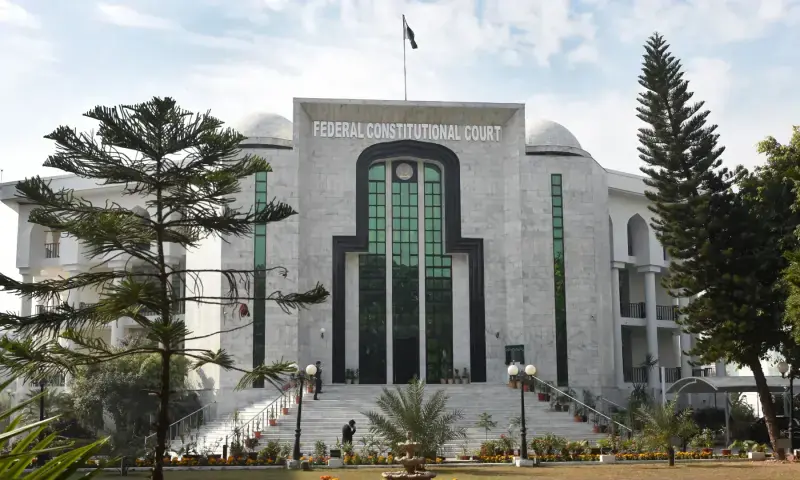
Key context: <p>ISLAMABAD: The Federal Constitutional Court (FCC) on Wednesday regretted the course adopted by a bench of the Supreme Court on an already determined matter by describing the approach as “something that raises serious concerns regarding judicial discipline, legal norms and institutional propriety”.</p> <p>“The course adopted in the subsequent order, authored by Justice Munib Akhtar, raises serious concerns regarding judicial discipline, legal norms and institutional propriety, particularly when the earlier determination remained operative and was already the subject of review proceedings,” observed FCC Chief Justice Aminuddin Khan in his <a rel="nofollow noopener noreferrer" target="_blank" class="link--external" href="https://fccp.gov.pk/api/public/site/files/d532c8c505070410ef65f45aa145785ea59e3b0f26778e57ec1015333a28d8fc">order</a>.</p> <p>A two-judge FCC bench, comprising Justice Aminuddin and Justice Ali Baqar Najafi, had taken up dozens of review petitions against a <a rel="nofollow noopener noreferrer" target="_blank" class="link--external" href="https://www.supremecourt.gov.pk/downloads_judgements/c.p._490_k_2020.pdf">Dec 28, 2021 SC judgment</a>, whereby leave to appeal was refused in a batch of petitions arising out of <a href="https://www.dawn.com/news/1566860">Sindh High Court’s 2020 order</a> concerning the constitutional validity of the Income Support Levy Act 2013.</p> <figure class='media w-full sm:w-1/2 media--right media--embed media--uneven' data-original-src='https://www.dawn.com/news/1566860'> <div class='media__item media__item--newskitlink '> <iframe class="nk-iframe" width="100%" frameborder="0" scrolling="no" style="height:250px;position:relative" src="https://www.dawn.com/news/card/1566860" sandbox="allow-same-origin allow-scripts allow-popups allow-modals allow-forms"></iframe></div> </figure> <p>The two-judge SC bench had upheld that the Income Support Levy Act, having been enacted through the Finance Act 2013 without observance of the legislative procedure prescribed by the Constitution, did not acquire the status of a valid law.</p> <p>The bench comprised Justice Aminuddin — who now heads the FCC formed under the <a href="https://www.dawn.com/news/1953890">26th Amendment</a> — and Justice Qazi Faez Isa, who went on to become the SC chief justice in 2023. Justice Isa penned the judgment.</p> <p>Despite the 2021 decision and the pendency of the present review petitions, a subsequent three-judge SC bench, including Justice Akhtar, through its June 21, 2022 order, granted leave on substantially identical constitutional questions and expressly contemplated reconsideration of the earlier determination.</p> <p>In his judgment, the FCC chief justice also criticised the SC’s subsequent conduct by describing the development as an aspect of institutional significance concerning judicial discipline and consistency of judicial pronouncements.</p> <p>Justice Aminuddin recalled that the constitutional validity of the Income Support Levy Act had already been examined by the two-judge SC bench in the ‘Commissioner Inland Revenue versus Muhammad Mustafa Gigi’ case in which the appeal was refused.</p> <p>The FCC top judge went on to express “serious concerns” over the 2022 SC ruling by Justice Akhtar.</p> <p>“It is a settled principle that coordinate or subsequent benches must accord due regard to earlier judicial determinations and any departure therefrom must conform to the established principles governing judicial precedent and the prescribed institutional procedure,” he stated.</p> <p>Although refusal of leave does not invariably preclude consideration of a distinct petition, a subsequent grant of leave cannot, by itself, operate to review, modify or displace an earlier determination, ruled the FCC.</p> <p>Judicial independence must be exercised consistently with judicial discipline, restraint and institutional decorum, the FCC chief justice stressed.</p> <figure class='media w-full sm:w-1/2 media--right media--embed media--uneven' data-original-src='https://www.dawn.com/news/1932181'> <div class='media__item media__item--newskitlink '> <iframe class="nk-iframe" width="100%" frameborder="0" scrolling="no" style="height:250px;position:relative" src="https://www.dawn.com/news/card/1932181" sandbox="allow-same-origin allow-scripts allow-popups allow-modals allow-forms"></iframe></div> </figure> <p>He added that the course adopted in the subsequent proceedings, insofar as it contemplated reconsideration of the 2021 judgment, “without recourse to the appropriate judicial mechanism, was inconsistent with these requirements”.</p> <p>“We reiterate that adherence to judicial discipline is indispensable to maintaining certainty, consistency and the institutional integrity of judicial adjudication,” Justice Aminuddin observed.</p> <p>Referring to the present review petitions, he noted that the 2021 SC judgment under review does not suffer from any error apparent on the face of the record or other fundamental defect warranting interference in review jurisdiction.</p> <p>The constitutional questions raised therein were duly examined and determined, and no sufficient legal ground was established for their reconsideration, Justice Aminuddin observed.</p> <p>Consequently, the instant review petitions were dismissed, and the Dec 28, 2021 judgment “shall remain undisturbed”.</p> <p>The FCC order recalled that the principal controversy determined by the 2021 SC ruling concerned the constitutional character of the Income Support Levy introduced through the Finance Act 2013, and whether the legislation imposing such levy could validly be enacted as a Money Bill within the contemplation of Article 73(2) of the Constitution.</p> <p>Upon consideration of these provisions, it concluded that the levy, notwithstanding its financial implications, did not fall within the constitutional classification of a Money Bill and that its enactment was consequently required to undergo the ordinary legislative procedure involving both Houses of Parliament.</p> <figure class='media w-full sm:w-1/2 media--right media--embed media--uneven' data-original-src='https://www.dawn.com/news/1758621'> <div class='media__item media__item--newskitlink '> <iframe class="nk-iframe" width="100%" frameborder="0" scrolling="no" style="height:250px;position:relative" src="https://www.dawn.com/news/card/1758621" sandbox="allow-same-origin allow-scripts allow-popups allow-modals allow-forms"></iframe></div> </figure> <p>“The distinction between a Money Bill and ordinary legislation is substantive and reflects the constitutional allocation of legislative authority between the two Houses of Parliament,” the FCC noted.</p> <p>It said that Article 73 (procedure with respect to Money Bill) constituted a “limited exception to the ordinary legislative procedure” prescribed under Article 70 (introduction and passing of bills) and cannot be expanded “merely by characterising a legislative measure as a levy or incorporating it into a Finance Act”.</p> This development from dawn.com highlights ongoing changes in the sector.
ISLAMABAD: The Federal Constitutional Court (FCC) on Wednesday regretted the course adopted by a bench of the Supreme Court on an already determined matter by describing the approach as “something that raises serious concerns regarding judicial discipline, legal norms and institutional propriety”. “The course adopted in the subsequent order, authored by Justice Munib Akhtar, raises serious concerns regarding judicial discipline, legal norms and institutional propriety, particularly when the earlier determination remained operative and was already the subject of review proceedings,” observed FCC Chief Justice Aminuddin Khan in his order. A two-judge FCC bench, comprising Justice Aminuddin and Justice Ali Baqar Najafi, had taken up dozens of review petitions against a Dec 28, 2021 SC judgment, whereby leave to appeal was refused in a batch of petitions arising out of Sindh High Court’s 2020 order concerning the constitutional validity of the Income Support Levy Act 2013. The two-judge SC bench had upheld that the Income Support Levy Act, having been enacted through the Finance Act 2013 without observance of the legislative procedure prescribed by the Constitution, did not acquire the status of a valid law. The bench comprised Justice Aminuddin — who now heads the FCC formed under the 26th Amendment — and Justice Qazi Faez Isa, who went on to become the SC chief justice in 2023. Justice Isa penned the judgment. Despite the 2021 decision and the pendency of the present review petitions, a subsequent three-judge SC bench, including Justice Akhtar, through its June 21, 2022 order, granted leave on substantially identical constitutional questions and expressly contemplated reconsideration of the earlier determination. In his judgment, the FCC chief justice also criticised the SC’s subsequent conduct by describing the development as an aspect of institutional significance concerning judicial discipline and consistency of judicial pronouncements. Justice Aminuddin recalled that the constitutional validity of the Income Support Levy Act had already been examined by the two-judge SC bench in the ‘Commissioner Inland Revenue versus Muhammad Mustafa Gigi’ case in which the appeal was refused. The FCC top judge went on to express “serious concerns” over the 2022 SC ruling by Justice Akhtar. “It is a settled principle that coordinate or subsequent benches must accord due regard to earlier judicial determinations and any departure therefrom must conform to the established principles governing judicial precedent and the prescribed institutional procedure,” he stated. Although refusal of leave does not invariably preclude consideration of a distinct petition, a subsequent grant of leave cannot, by itself, operate to review, modify or displace an earlier determination, ruled the FCC. Judicial independence must be exercised consistently with judicial discipline, restraint and institutional decorum, the FCC chief justice stressed. He added that the course adopted in the subsequent proceedings, insofar as it contemplated reconsideration of the 2021 judgment, “without recourse to the appropriate judicial mechanism, was inconsistent with these requirements”. “We reiterate that adherence to judicial discipline is indispensable to maintaining certainty, consistency and the institutional integrity of judicial adjudication,” Justice Aminuddin observed. Referring to the present review petitions, he noted that the 2021 SC judgment under review does not suffer from any error apparent on the face of the record or other fundamental defect warranting interference in review jurisdiction. The constitutional questions raised therein were duly examined and determined, and no sufficient legal ground was established for their reconsideration, Justice Aminuddin observed. Consequently, the instant review petitions were dismissed, and the Dec 28, 2021 judgment “shall remain undisturbed”. The FCC order recalled that the principal controversy determined by the 2021 SC ruling concerned the constitutional character of the Income Support Levy introduced through the Finance Act 2013, and whether the legislation imposing such levy could validly be enacted as a Money Bill within the contemplation of Article 73(2) of the Constitution. Upon consideration of these provisions, it concluded that the levy, notwithstanding its financial implications, did not fall within the constitutional classification of a Money Bill and that its enactment was consequently required to undergo the ordinary legislative procedure involving both Houses of Parliament. “The distinction between a Money Bill and ordinary legislation is substantive and reflects the constitutional allocation of legislative authority between the two Houses of Parliament,” the FCC noted. It said that Article 73 (procedure with respect to Money Bill) constituted a “limited exception to the ordinary legislative procedure” prescribed under Article 70 (introduction and passing of bills) and cannot be expanded “merely by characterising a legislative measure as a levy or incorporating it into a Finance Act”.
Curation & Context
This page summarizes a public news report from dawn.com. Global News Hub provides the "Why This Matters" takeaway using editorial insights and AI curation to give readers rapid, high-value context before they click through to read the full article.