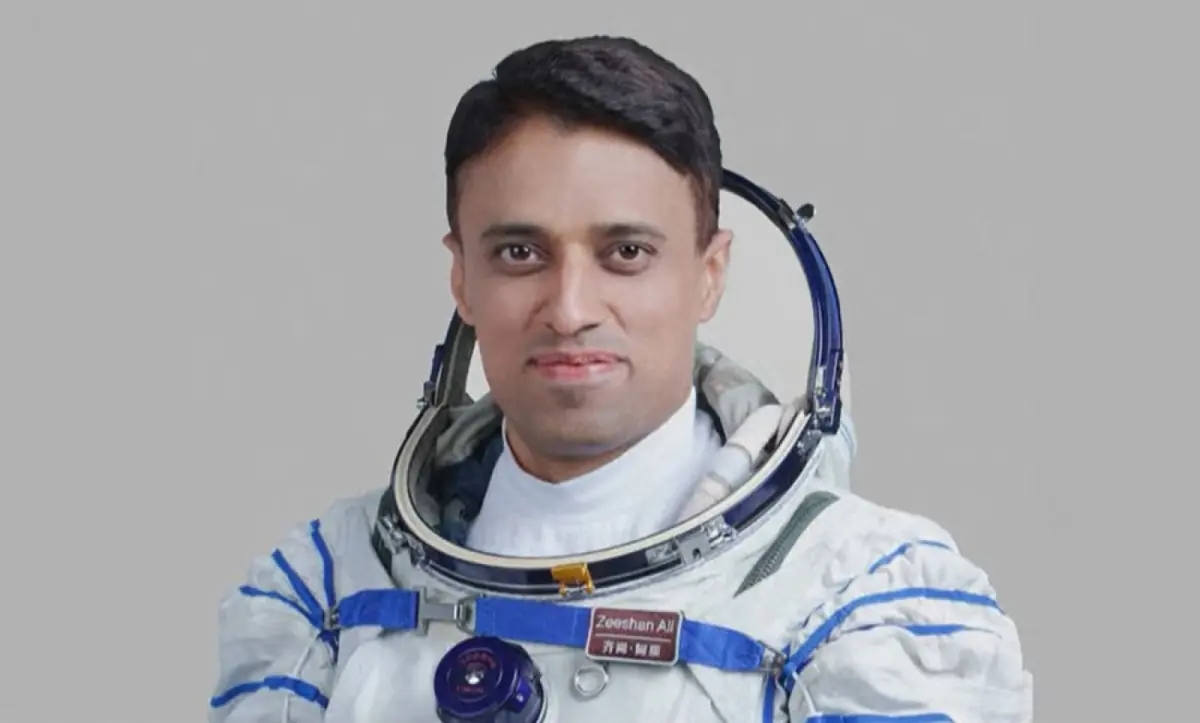
'Carrying hopes of 250m people': Zeeshan Ali to be first Pakistani in space aboard China's Shenzhou-24
Why This Matters
Key context: <p>Pakistan’s Zeeshan Ali was named a crew member of China’s Shenzhou-24 space mission on Tuesday, which is scheduled to launch on November 25, with Ali set to become the first foreign national to board Beijing’s Tiangong space station, the China Manned Space Agency (CMSA) announced.</p> <p>According to the CMSA, the Pakistani astronaut will serve as a payload specialist during the mission and return aboard the Shenzhou-23 spacecraft, which docked with the Tiangong space station in May.</p> <p>Chinese astronauts Tang Hongbo and Wu Yi are part of the three-member mission, according to the CMSA.</p> <figure class='media w-full w-full media-- media--embed media--uneven media--tweet' data-original-src='https://x.com/CGTNOfficial/status/2125041640868065405?a=fmuOIUI74kapkNTKBeQ&s=19'> <div class='media__item media__item--twitter '><span> <blockquote class="twitter-tweet" lang="en"> <a href="https://twitter.com/CGTNOfficial/status/2125041640868065405?a=fmuOIUI74kapkNTKBeQ&s=19"></a> </blockquote> </span></div> </figure> <p>The crewed spaceship is scheduled to be launched at 8:18am (Beijing Time and 5:18am Pakistan Time) on Wednesday from the Jiuquan Satellite Launch Center in northwest China.</p> <p>Zeeshan is expected to spend around a week in space, conducting various experiments alongside the Chinese crew. CMSA said that during the mission, the crew will conduct around 90 experiments.</p> <p>The Chinese space agency said the mission’s objectives included conducting an orbital rotation with the crew of the earlier Shenzhou-23 mission, carrying out routine operations and maintenance of the Chinese space station, and continuing space science research, including experiments involving space payloads.</p> <figure class='media w-full w-full media-- media--embed media--uneven media--tweet' data-original-src='https://x.com/betterpakistan/status/2125044708179321213?a=1sXYmEGiry0hMTVRx9g&s=19'> <div class='media__item media__item--twitter '><span> <blockquote class="twitter-tweet" lang="en"> <a href="https://twitter.com/betterpakistan/status/2125044708179321213?a=1sXYmEGiry0hMTVRx9g&s=19"></a> </blockquote> </span></div> </figure> <h2><a id="space-dream-becoming-reality" href="#space-dream-becoming-reality" class="heading-permalink" aria-hidden="true" tabindex="-1" title="Permalink"></a>‘Space dream becoming reality’</h2> <p>Speaking at a press briefing in Jiayuguan, Ali said he was “deeply grateful” to the Chinese government for helping “us realise our dream of going into space”.</p> <p>He said he arrived at the Astronaut Centre of China a few months ago, carrying with him the hopes of 250 million Pakistani people.</p> <p>Detailing his experience in China, he said what he gained had far exceeded his initial expectations. “First, I have acquired space flight skills. The management, staff and instructors at the Astronaut Centre of China have provided me with comprehensive training […] Day after day, I take another step upward.”</p> <p>Moreover, he continued, “I have learned the Chinese language and developed a friendship with my Chinese colleagues. Now, I can communicate with my Chinese crewmates in Chinese.</p> <p>“We trained side by side, and our friendship embodies the friendship between China and Pakistan: higher than the mountains, deeper than the oceans, sweeter than honey and as vast as outer space.”</p> <p>He said he had come to deeply appreciate the meaning of Chinese President Xi Jinping’s words: “Exploring the vast universe, developing the space industry and building China into a space power is our unremitting pursuit of the space dream.”</p> <p>“Now, this dream belongs to me and also belongs to Pakistan,” he said, adding that it would become a reality through the Shenzhou-24 space mission.</p> <p>Planning Minister Ahsan Iqbal congratulated Zeeshan and said the joint mission marked “the trust and iron brotherhood between Pakistan and China”.</p> <p>Information Minister Attaullah Tarar posted on X that a Pakistani astronaut going into space was a source of joy and pride for the entire nation.</p> <figure class='media w-full w-full media-- media--embed media--uneven media--tweet' data-original-src='https://x.com/TararAttaullah/status/2125049939680223542'> <div class='media__item media__item--twitter '><span> <blockquote class="twitter-tweet" lang="en"> <a href="https://twitter.com/TararAttaullah/status/2125049939680223542"></a> </blockquote> </span></div> </figure> <p>Earlier in April, astronauts <a href="https://www.dawn.com/news/1994090">Muhammad Zeeshan Ali and Khurram Daud</a> were chosen to start training in China.</p> <p>Prime Minister Shehbaz Sharif <a href="https://www.dawn.com/news/1994354">met the two</a> in April, and congratulated them on their selection. He said the space mission was a “matter of pride for the entire nation” and further commended their “round-the-clock efforts” in achieving the milestone.</p> <p>PM Shehbaz hoped that the space mission would “add new dimensions to the brotherly relationship between Pakistan and China”.</p> <p>Beijing has invested heavily in its space programme in recent years — catching up with its main rival the United States — and aims to land astronauts on the Moon by 2030.</p> <p>Pakistan is a natural partner, given the country’s decades-long, “all-weather” friendship. China is Pakistan’s largest trading partner and a major foreign investor.</p> <p>In February 2025, Suparco and CMSA signed a cooperation agreement. Under the pact, two Pakistanis were to train in China, with one joining a mission on the Tiangong space station operated by Beijing.</p> <p>China has been barred from participating in the International Space Station since 2011, when the US prohibited Nasa from collaborating with Chinese space agencies. Since then, Beijing has sought to build partnerships with other countries — including Pakistan — in its expanding space programme.</p> This development from dawn.com highlights ongoing changes in the sector.
Pakistan’s Zeeshan Ali was named a crew member of China’s Shenzhou-24 space mission on Tuesday, which is scheduled to launch on November 25, with Ali set to become the first foreign national to board Beijing’s Tiangong space station, the China Manned Space Agency (CMSA) announced. According to the CMSA, the Pakistani astronaut will serve as a payload specialist during the mission and return aboard the Shenzhou-23 spacecraft, which docked with the Tiangong space station in May. Chinese astronauts Tang Hongbo and Wu Yi are part of the three-member mission, according to the CMSA. The crewed spaceship is scheduled to be launched at 8:18am (Beijing Time and 5:18am Pakistan Time) on Wednesday from the Jiuquan Satellite Launch Center in northwest China. Zeeshan is expected to spend around a week in space, conducting various experiments alongside the Chinese crew. CMSA said that during the mission, the crew will conduct around 90 experiments. The Chinese space agency said the mission’s objectives included conducting an orbital rotation with the crew of the earlier Shenzhou-23 mission, carrying out routine operations and maintenance of the Chinese space station, and continuing space science research, including experiments involving space payloads. ‘Space dream becoming reality’ Speaking at a press briefing in Jiayuguan, Ali said he was “deeply grateful” to the Chinese government for helping “us realise our dream of going into space”. He said he arrived at the Astronaut Centre of China a few months ago, carrying with him the hopes of 250 million Pakistani people. Detailing his experience in China, he said what he gained had far exceeded his initial expectations. “First, I have acquired space flight skills. The management, staff and instructors at the Astronaut Centre of China have provided me with comprehensive training […] Day after day, I take another step upward.” Moreover, he continued, “I have learned the Chinese language and developed a friendship with my Chinese colleagues. Now, I can communicate with my Chinese crewmates in Chinese. “We trained side by side, and our friendship embodies the friendship between China and Pakistan: higher than the mountains, deeper than the oceans, sweeter than honey and as vast as outer space.” He said he had come to deeply appreciate the meaning of Chinese President Xi Jinping’s words: “Exploring the vast universe, developing the space industry and building China into a space power is our unremitting pursuit of the space dream.” “Now, this dream belongs to me and also belongs to Pakistan,” he said, adding that it would become a reality through the Shenzhou-24 space mission. Planning Minister Ahsan Iqbal congratulated Zeeshan and said the joint mission marked “the trust and iron brotherhood between Pakistan and China”. Information Minister Attaullah Tarar posted on X that a Pakistani astronaut going into space was a source of joy and pride for the entire nation. Earlier in April, astronauts Muhammad Zeeshan Ali and Khurram Daud were chosen to start training in China. Prime Minister Shehbaz Sharif met the two in April, and congratulated them on their selection. He said the space mission was a “matter of pride for the entire nation” and further commended their “round-the-clock efforts” in achieving the milestone. PM Shehbaz hoped that the space mission would “add new dimensions to the brotherly relationship between Pakistan and China”. Beijing has invested heavily in its space programme in recent years — catching up with its main rival the United States — and aims to land astronauts on the Moon by 2030. Pakistan is a natural partner, given the country’s decades-long, “all-weather” friendship. China is Pakistan’s largest trading partner and a major foreign investor. In February 2025, Suparco and CMSA signed a cooperation agreement. Under the pact, two Pakistanis were to train in China, with one joining a mission on the Tiangong space station operated by Beijing. China has been barred from participating in the International Space Station since 2011, when the US prohibited Nasa from collaborating with Chinese space agencies. Since then, Beijing has sought to build partnerships with other countries — including Pakistan — in its expanding space programme.
Curation & Context
This page summarizes a public news report from dawn.com. Global News Hub provides the "Why This Matters" takeaway using editorial insights and AI curation to give readers rapid, high-value context before they click through to read the full article.