DPM Dar, Asean secretary general agree to enhance cooperation to address ‘non-traditional’ security challenges
Why This Matters
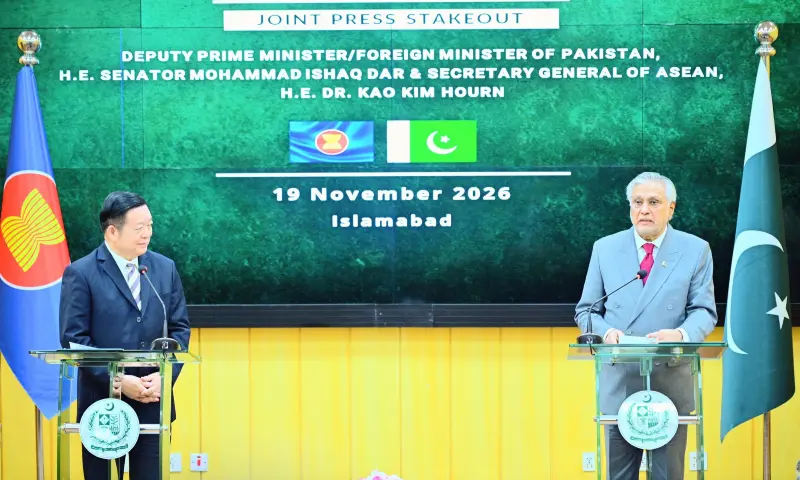
Key context: <p>Deputy Prime Minister and Foreign Minister Ishaq Dar and Secretary General of the Association of Southeast Asian Nations (Asean) Dr Kao Kim Hourn agreed to enhance cooperation in addressing “non-traditional” security challenges on Thursday.</p> <p>Addressing a joint press stakeout with Hourn after delegation-level talks held at the Ministry of Foreign Affairs, DPM Dar said that the discussions had focused on strengthening political, economic and socio-cultural cooperation.</p> <p>“We agreed to enhance cooperation in addressing non-traditional security challenges, including climate change, food insecurity, disruptions to energy supplies and cyber threats,” he said.</p> <p>“Our ability to respond to these challenges together is vital to the security of our people and the sustainability of our development.”</p> <p>Dar added that the two sides had discussed ways to expand cooperation in trade, education, technology, climate change and food security while promoting cultural and people-to-people exchanges.</p> <p>He stressed that economic cooperation was central to their discussions, including facilitating trade, improving connectivity and enhancing digital integration, with a focus on creating more opportunities for businesses and strengthening the links between Asean and Pakistan’s markets.</p> <p>“Building on the Asean-Pakistan business conferences, we look forward to partnerships that connect businesses, open new markets and create more jobs,” he said.</p> <p>The two sides also discussed strengthening links between universities and research institutions in order to encourage joint research, exchange of expertise and skill development, particularly in digital technologies and artificial intelligence; as well as to increase cultural, academic and youth exchanges.</p> <p>They also discussed regional and international security, the deputy premier said, highlighting Asean’s role in promoting dialogue and regional integration at a time of growing political uncertainty and an evolving geopolitical landscape, including by bringing countries together around shared interests.</p> <p>“Pakistan values this approach and looks forward to closer engagement with Asean to advance peace and shared prosperity,” Dar said.</p> <p>He stressed the importance of secure sea routes and uninterrupted supply chains for economies and livelihoods, adding that the two leaders reaffirmed the central role of dialogue and diplomacy, respect for international law and adherence to the United Nations Charter in addressing challenges and expressing Pakistan’s continued engagement with key partners in this regard.</p> <p>He also expressed concern over the continued expansion of illegal settlements in the West Bank, calling for unhindered humanitarian assistance to be delivered to Gaza and reiterating his support for an independent Palestinian state.</p> <p>Regarding the situation in South Asia, he also briefed Hourn on the importance of “a just, durable and peaceful settlement of the longstanding Jammu and Kashmir dispute in accordance with relevant UN Security Council resolutions”, while also expressing concern over India’s unilateral decision to hold the Indus Water Treaty in abeyance, threatening water, food and energy security for Pakistan. He also highlighted Pakistan’s concern over the continued use of Afghan soil for carrying out terrorist attacks.</p> <p>DPM Dar said that Hourn’s visit — the first by an Asean secretary general in over two decades — offered an opportunity to build on the close friendly ties between Pakistan and Asean.</p> <p>“We look forward to giving fresh impetus to our partnership through practical cooperation that benefits our people,” he said.</p> <p>Hourn, during his address, underscored the potential to deepen Pakistan-Asean relations in the areas of economic cooperation, regional peace and security, and people-to-people connectivity, translating their longstanding relationship into “more substantive cooperation and tangible benefits”.</p> <p>He called for stronger connections between the business communities and noted promising opportunities in the renewable energy sector, as well as the potential to deepen cooperation against shared international challenges including terrorism, violent extremism, human trafficking and international crime.</p> <p>“I would encourage Pakistan to make greater use of Asean’s various centres and institutions as a platform for capacity building, technical cooperation and knowledge sharing, drawing on experience and expertise available between our two sides,” he said.</p> <p>In addition, he welcomed Pakistan’s constructive role in facilitating negotiations between the US and Iran, which resulted in the signing of the Islamabad Memorandum of Understanding in June, and acknowledged the country’s efforts to facilitate dialogue and de-escalation.</p> <p>Hourn is on a working visit to Pakistan from November 18 to 20.</p> <p>In their delegation-level talks, the two sides reviewed progress under the Pakistan-Asean Sectoral Dialogue Partnership, the Foreign Office (FO) said in a post on X.</p> <figure class='media w-full w-full media-- media--embed media--uneven media--tweet' data-original-src='https://x.com/ForeignOfficePk/status/2123344358833537356'> <div class='media__item media__item--twitter '><span> <blockquote class="twitter-tweet" lang="en"> <a href="https://twitter.com/ForeignOfficePk/status/2123344358833537356"></a> </blockquote> </span></div> </figure> <p>According to the handout, the discussions between the two sides focused on expanding trade and investment, strengthening regional connectivity, and deepening cooperation in agriculture and food security.</p> <p>Collaboration on climate resilience, disaster preparedness, and digital innovation also came under discussion.</p> <p>During the talks, DPM Dar stressed the scope for closer links between the business communities of Pakistan and Asean member states as well as the significance of scholarships, student exchanges, and joint research to strengthen people-to-people ties.</p> <p>The FO added that the two sides also exchanged views on regional developments and appreciated Pakistan’s “constructive role” in promoting regional peace and stability.</p> <p>DPM Dar reaffirmed Pakistan’s commitment to working closely with the Asean Secretariat and member states to advance the partnership.</p> <p>Separately, the secretary general called on Prime Minister Shehbaz Sharif in Islamabad, where they discussed ways to enhance trade, investment and economic cooperation and expand collaboration in food security, climate change, IT and education, the FO said.</p> <p>PM Shehbaz underscored the importance of “translating the existing goodwill into concrete economic and development partnerships”, highlighting Pakistan’s strategic location at the crossroads of Central Asia, the Middle East and West Asia and its potential as a gateway for the wider region.</p> <p>Hourn “reaffirmed Asean’s commitment to strengthening relations with Pakistan, welcomed Pakistan’s interest in closer engagement, and expressed confidence that continued cooperation and the visit would help advance the partnership”, the FO added.</p> <figure class='media w-full w-full media-- media--embed media--uneven media--tweet' data-original-src='https://x.com/PakPMO/status/2123412598045782212'> <div class='media__item media__item--twitter '><span> <blockquote class="twitter-tweet" lang="en"> <a href="https://twitter.com/PakPMO/status/2123412598045782212"></a> </blockquote> </span></div> </figure> <p>A day earlier, the FO had said Hourn’s arrival marked the first high-level visit to Pakistan from the Asean Secretariat.</p> <p>Pakistan has been an Asean Sectoral Dialogue Partner since 1993, and a member of the Asean Regional Forum since 2004, it added.</p> <p>Asean was founded on August 8, 1967, when Indonesia, Malaysia, the Philippines, Singapore, and Thailand signed the Bangkok Declaration, setting goals for economic and other types of cooperation and regional peace and stability.</p> <p>The bloc has 11 members, including Brunei, Vietnam, Laos, Myanmar, Cambodia, and East Timor.</p> <p>“The visit underscores Pakistan and Asean’s shared commitment to deepening and diversifying cooperation,” FO said in its Wednesday statement.</p> <p>Earlier this year, Dar <a href="https://www.dawn.com/news/2017480"><u>attended </u></a>the 33rd Ministerial Meeting of the Asean Regional Forum in Manila, where he <a href="https://www.dawn.com/news/2017915"><u>drew attention</u></a> to key challenges threatening peaceful coexistence and stability across the world, listing the Kashmir dispute and India’s threats to Pakistan’s share of water among them.</p> <p>Last year, seven Asean member countries <a href="https://www.dawn.com/news/1952491/asean-envoys-explore-investment-opportunities"><u>held a joint meeting</u></a> with Minister for Investment Qaiser Ahmed Sheikh to explore new avenues of investment and economic cooperation with Pakistan.</p> This development from dawn.com highlights ongoing changes in the sector.
Deputy Prime Minister and Foreign Minister Ishaq Dar and Secretary General of the Association of Southeast Asian Nations (Asean) Dr Kao Kim Hourn agreed to enhance cooperation in addressing “non-traditional” security challenges on Thursday. Addressing a joint press stakeout with Hourn after delegation-level talks held at the Ministry of Foreign Affairs, DPM Dar said that the discussions had focused on strengthening political, economic and socio-cultural cooperation. “We agreed to enhance cooperation in addressing non-traditional security challenges, including climate change, food insecurity, disruptions to energy supplies and cyber threats,” he said. “Our ability to respond to these challenges together is vital to the security of our people and the sustainability of our development.” Dar added that the two sides had discussed ways to expand cooperation in trade, education, technology, climate change and food security while promoting cultural and people-to-people exchanges. He stressed that economic cooperation was central to their discussions, including facilitating trade, improving connectivity and enhancing digital integration, with a focus on creating more opportunities for businesses and strengthening the links between Asean and Pakistan’s markets. “Building on the Asean-Pakistan business conferences, we look forward to partnerships that connect businesses, open new markets and create more jobs,” he said. The two sides also discussed strengthening links between universities and research institutions in order to encourage joint research, exchange of expertise and skill development, particularly in digital technologies and artificial intelligence; as well as to increase cultural, academic and youth exchanges. They also discussed regional and international security, the deputy premier said, highlighting Asean’s role in promoting dialogue and regional integration at a time of growing political uncertainty and an evolving geopolitical landscape, including by bringing countries together around shared interests. “Pakistan values this approach and looks forward to closer engagement with Asean to advance peace and shared prosperity,” Dar said. He stressed the importance of secure sea routes and uninterrupted supply chains for economies and livelihoods, adding that the two leaders reaffirmed the central role of dialogue and diplomacy, respect for international law and adherence to the United Nations Charter in addressing challenges and expressing Pakistan’s continued engagement with key partners in this regard. He also expressed concern over the continued expansion of illegal settlements in the West Bank, calling for unhindered humanitarian assistance to be delivered to Gaza and reiterating his support for an independent Palestinian state. Regarding the situation in South Asia, he also briefed Hourn on the importance of “a just, durable and peaceful settlement of the longstanding Jammu and Kashmir dispute in accordance with relevant UN Security Council resolutions”, while also expressing concern over India’s unilateral decision to hold the Indus Water Treaty in abeyance, threatening water, food and energy security for Pakistan. He also highlighted Pakistan’s concern over the continued use of Afghan soil for carrying out terrorist attacks. DPM Dar said that Hourn’s visit — the first by an Asean secretary general in over two decades — offered an opportunity to build on the close friendly ties between Pakistan and Asean. “We look forward to giving fresh impetus to our partnership through practical cooperation that benefits our people,” he said. Hourn, during his address, underscored the potential to deepen Pakistan-Asean relations in the areas of economic cooperation, regional peace and security, and people-to-people connectivity, translating their longstanding relationship into “more substantive cooperation and tangible benefits”. He called for stronger connections between the business communities and noted promising opportunities in the renewable energy sector, as well as the potential to deepen cooperation against shared international challenges including terrorism, violent extremism, human trafficking and international crime. “I would encourage Pakistan to make greater use of Asean’s various centres and institutions as a platform for capacity building, technical cooperation and knowledge sharing, drawing on experience and expertise available between our two sides,” he said. In addition, he welcomed Pakistan’s constructive role in facilitating negotiations between the US and Iran, which resulted in the signing of the Islamabad Memorandum of Understanding in June, and acknowledged the country’s efforts to facilitate dialogue and de-escalation. Hourn is on a working visit to Pakistan from November 18 to 20. In their delegation-level talks, the two sides reviewed progress under the Pakistan-Asean Sectoral Dialogue Partnership, the Foreign Office (FO) said in a post on X. According to the handout, the discussions between the two sides focused on expanding trade and investment, strengthening regional connectivity, and deepening cooperation in agriculture and food security. Collaboration on climate resilience, disaster preparedness, and digital innovation also came under discussion. During the talks, DPM Dar stressed the scope for closer links between the business communities of Pakistan and Asean member states as well as the significance of scholarships, student exchanges, and joint research to strengthen people-to-people ties. The FO added that the two sides also exchanged views on regional developments and appreciated Pakistan’s “constructive role” in promoting regional peace and stability. DPM Dar reaffirmed Pakistan’s commitment to working closely with the Asean Secretariat and member states to advance the partnership. Separately, the secretary general called on Prime Minister Shehbaz Sharif in Islamabad, where they discussed ways to enhance trade, investment and economic cooperation and expand collaboration in food security, climate change, IT and education, the FO said. PM Shehbaz underscored the importance of “translating the existing goodwill into concrete economic and development partnerships”, highlighting Pakistan’s strategic location at the crossroads of Central Asia, the Middle East and West Asia and its potential as a gateway for the wider region. Hourn “reaffirmed Asean’s commitment to strengthening relations with Pakistan, welcomed Pakistan’s interest in closer engagement, and expressed confidence that continued cooperation and the visit would help advance the partnership”, the FO added. A day earlier, the FO had said Hourn’s arrival marked the first high-level visit to Pakistan from the Asean Secretariat. Pakistan has been an Asean Sectoral Dialogue Partner since 1993, and a member of the Asean Regional Forum since 2004, it added. Asean was founded on August 8, 1967, when Indonesia, Malaysia, the Philippines, Singapore, and Thailand signed the Bangkok Declaration, setting goals for economic and other types of cooperation and regional peace and stability. The bloc has 11 members, including Brunei, Vietnam, Laos, Myanmar, Cambodia, and East Timor. “The visit underscores Pakistan and Asean’s shared commitment to deepening and diversifying cooperation,” FO said in its Wednesday statement. Earlier this year, Dar attended the 33rd Ministerial Meeting of the Asean Regional Forum in Manila, where he drew attention to key challenges threatening peaceful coexistence and stability across the world, listing the Kashmir dispute and India’s threats to Pakistan’s share of water among them. Last year, seven Asean member countries held a joint meeting with Minister for Investment Qaiser Ahmed Sheikh to explore new avenues of investment and economic cooperation with Pakistan.
Curation & Context
This page summarizes a public news report from dawn.com. Global News Hub provides the "Why This Matters" takeaway using editorial insights and AI curation to give readers rapid, high-value context before they click through to read the full article.