‘A new era begins’: Pakistan’s Zeeshan Ali enters new frontier as Shenzhou-24 docks with space station
Why This Matters
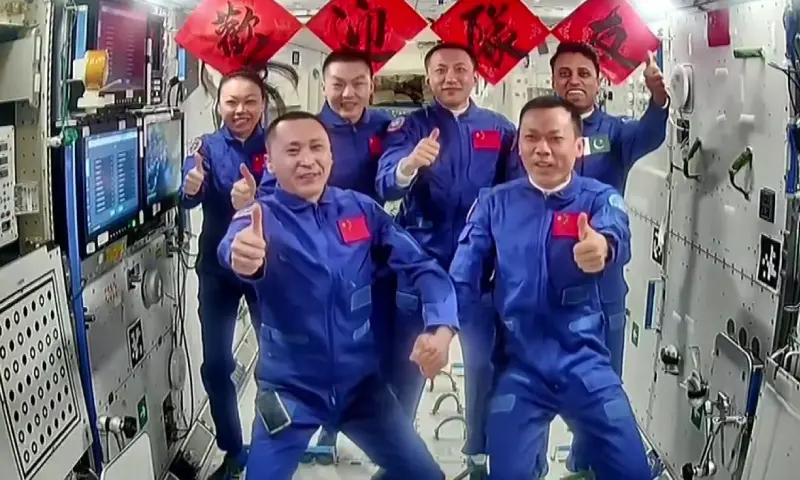
Key context: <p>China’s Shenzhou-24 spacecraft, carrying 40-year-old Pakistani astronaut Zeeshan Ali, successfully docked with the Tiangong space station three hours and 38 minutes after liftoff, the China Manned Space Agency (CMSA) confirmed on Wednesday.</p> <figure class='media w-full w-full media-- media--embed media--uneven media--tweet' data-original-src='https://x.com/CNSpaceflight/status/2125446549509734529'> <div class='media__item media__item--twitter '><span> <blockquote class="twitter-tweet" lang="en"> <a href="https://twitter.com/CNSpaceflight/status/2125446549509734529"></a> </blockquote> </span></div> </figure> <p>Ali became the first Pakistani astronaut to enter orbit after the Shenzhou-24 spacecraft successfully reached its preset orbit following liftoff from the Jiuquan Satellite Launch Centre earlier today. And he is also the first foreign national to board the Tiangong space station.</p> <figure class='media w-full w-full media-- media--embed media--uneven media--tweet' data-original-src='https://x.com/XHNews/status/2125448035526394059'> <div class='media__item media__item--twitter '><span> <blockquote class="twitter-tweet" lang="en"> <a href="https://twitter.com/XHNews/status/2125448035526394059"></a> </blockquote> </span></div> </figure> <p>A Long March 2-F rocket was used for the launch. It took off in a cloud of flames and smoke at 8:18am Beijing Time (5:18am Pakistan Time) under a pink sky, video from state broadcaster <em>CCTV</em> showed.</p> <figure class='media w-full w-full media-- media--embed media--uneven media--tweet' data-original-src='https://x.com/CCTV_Plus/status/2125331334814142856'> <div class='media__item media__item--twitter '><span> <blockquote class="twitter-tweet" lang="en"> <a href="https://twitter.com/CCTV_Plus/status/2125331334814142856"></a> </blockquote> </span></div> </figure> <p>A send-off ceremony was also held for three astronauts who make up the mission’s crew at the launch centre before they entered the spacecraft capsule.</p> <p>The spacecraft successfully separated from the carrier rocket roughly 10 minutes after lift-off and entered orbit, the CMSA said.</p> <figure class='media w-full w-full media-- media--embed media--uneven media--tweet' data-original-src='https://x.com/CCTV_Plus/status/2125353755885629632'> <div class='media__item media__item--twitter '><span> <blockquote class="twitter-tweet" lang="en"> <a href="https://twitter.com/CCTV_Plus/status/2125353755885629632"></a> </blockquote> </span></div> </figure> <p>“The spacecraft is functioning well. I declare the Shenzhou-24 launch mission a complete success,” an official at the Jiuquan Satellite Launch Centre announced.</p> <h2><a id="90-experiments" href="#90-experiments" class="heading-permalink" aria-hidden="true" tabindex="-1" title="Permalink"></a>90 experiments</h2> <p>China’s Tang Hongbo is commanding the mission, with Wu Yi serving as mission pilot and Ali as payload specialist.</p> <p>Ali is expected to spend around a week in space, conducting various experiments alongside the Chinese crew. Pakistan’s space agency, Suparco, said Ali would conduct experiments in orbit, including cultivating microalgae as a potential food and oxygen source for future space missions, and testing the effects of spaceflight on quinoa seeds.</p> <p>Meanwhile, the CMSA said the crew would conduct around 90 experiments during the mission.</p> <p>The agency said the mission’s objectives included conducting an orbital rotation with the crew of the earlier <a href="https://www.dawn.com/news/2002786">Shenzhou-23 mission</a>, carrying out routine operations and maintenance of the space station, and continuing space science research, including experiments involving space payloads.</p> <h2><a id="pakistani-flag-rises-into-orbit" href="#pakistani-flag-rises-into-orbit" class="heading-permalink" aria-hidden="true" tabindex="-1" title="Permalink"></a>‘Pakistani flag rises into orbit’</h2> <p>Planning Minister Ahsan Iqbal, who is in China, witnessed the send-off and the mission’s launch.</p> <p>Later, he posted on X: “As Shenzhou-24 lifts off this morning, Nov 25, carrying Zeeshan Ali, Pakistan’s first astronaut, a new era begins for Pakistan’s space programme. With him, the Pakistani flag rises into orbit, lifting the hopes and aspirations of 260 million Pakistanis for technological advancement and space exploration. From highways to information super highways to skyways, Pakistan-China friendship and CPEC rises higher than the skies.</p> <p>“This is Pakistan’s URAAN (flight) into space, and it is only the beginning of a brighter and more glorious future.”</p> <figure class='media w-full w-full media-- media--embed media--uneven media--tweet' data-original-src='https://x.com/betterpakistan/status/2125396909452059054'> <div class='media__item media__item--twitter '><span> <blockquote class="twitter-tweet" lang="en"> <a href="https://twitter.com/betterpakistan/status/2125396909452059054"></a> </blockquote> </span></div> </figure> <p>In Pakistan, Deputy Prime Minister and Foreign Minister Ishaq Dar congratulated the people of Pakistan and China on the successful launch of Shenzhou-24.</p> <p>“This historic mission marks a significant milestone in our all-weather strategic cooperative partnership as we commemorate 75 years of diplomatic relations.</p> <p>“I thank President Xi Jinping and the Chinese leadership for their support and commend the teams of both countries for this achievement, which reflects our enduring friendship and commitment to the peaceful exploration of space,” he posted on X.</p> <p>Dar said it was a “proud moment” for Pakistan, and this mission would inspire the country’s youth and advance its aspirations in science and technology.</p> <p>“My best wishes to our astronaut Muhammad Zeeshan Ali and the Chinese crew for a safe journey and a successful mission,” he concluded.</p> <figure class='media w-full w-full media-- media--embed media--uneven media--tweet' data-original-src='https://x.com/MIshaqDar50/status/2125435348864180342'> <div class='media__item media__item--twitter '><span> <blockquote class="twitter-tweet" lang="en"> <a href="https://twitter.com/MIshaqDar50/status/2125435348864180342"></a> </blockquote> </span></div> </figure> <h2><a id="zardari-xi-exchange-letters" href="#zardari-xi-exchange-letters" class="heading-permalink" aria-hidden="true" tabindex="-1" title="Permalink"></a>Zardari, Xi exchange letters</h2> <p>Meanwhile, the Presidency in Islamabad said in a statement that President Asif Ali Zardari had exchanged letters with his Chinese counterpart on the “landmark Pakistan-China space cooperation achievement”.</p> <p>The statement said the two leaders congratulated each other on the “historic milestone in Pakistan-China space cooperation, marked by the first spaceflight of a Pakistani astronaut to China’s space station aboard the Shenzhou spacecraft, making him the first foreign astronaut to enter the Chinese space station”.</p> <p>President Zardari extended felicitations to the government and people of China and expressed his “profound appreciation” for selecting Pakistan as the first foreign partner in China’s manned space programme, the statement said. It added that he further acknowledged the “invaluable support, professionalism and dedication” of the CMSA and the Astronaut Centre of China in making the collaboration possible.</p> <p>President Zardari said the achievement “reflects China’s remarkable progress in space science and technology as well as its commitment to international cooperation in the peaceful exploration and use of outer space”.</p> <figure class='media w-full w-full media-- media--embed media--uneven media--tweet' data-original-src='https://x.com/PresOfPakistan/status/2125473672714736027'> <div class='media__item media__item--twitter '><span> <blockquote class="twitter-tweet" lang="en"> <a href="https://twitter.com/PresOfPakistan/status/2125473672714736027"></a> </blockquote> </span></div> </figure> <p>He said the initiative embodied the “vision of building a community with a shared future for mankind, based on mutual progress, shared opportunities and collective advancement”.</p> <p>He further wrote: “Pakistan takes immense pride in this historic achievement, which stands as another testament to the enduring friendship, mutual trust and close cooperation between the two countries.”</p> <p>The president noted that collaboration between CMSA and Suparco had opened new avenues for bilateral cooperation in science, technology and space exploration.</p> <p>He expressed confidence that the “achievement would inspire generations of young Pakistanis to pursue excellence in scientific research, innovation and technological advancement”.</p> <p>In his letter, President Xi congratulated the government and people of Pakistan, the astronauts of both countries and their teams in the space industry.</p> <p>President Xi said the astronauts from both countries “joining hands in the quest for the universe represents a living testament to their deep-rooted friendship and a new and significant outcome of bilateral cooperation”.</p> <p>He noted that exploration was never-ending as the cosmos is boundless.</p> <p>“The Chinese space station is an ark of peace, friendship and cooperation. China, together with [other] countries, including Pakistan, stands ready to hold high the banner of peaceful uses of outer space, deepen international space cooperation and improve global outer space governance, to ensure that outer space exploration delivers greater benefits to the humanity,” he added.</p> <h2><a id="carrying-hopes-of-250m-pakistanis" href="#carrying-hopes-of-250m-pakistanis" class="heading-permalink" aria-hidden="true" tabindex="-1" title="Permalink"></a>‘Carrying hopes of 250m Pakistanis’</h2> <p>In April, <a href="https://www.dawn.com/news/1994090"><u>Zeeshan Ali and Khurram Daud</u></a> were chosen from Pakistan to start training in China. Pakistan’s space agency Suparco and CMSA signed a cooperation agreement in February 2025, under which two Pakistanis were to train in China, with one joining a mission on the Tiangong space station operated by Beijing.</p> <p>Eventually, Ali was chosen to join the Chinese mission.</p> <p><a href="https://www.dawn.com/news/2046714/carrying-hopes-of-250m-people-zeeshan-ali-to-be-first-pakistani-astronaut-in-space-aboard-chinas-shenzhou-24">Speaking at a press briefing</a> in Jiayuguan on Tuesday, Ali said he was “deeply grateful” to the Chinese government for helping “us realise our dream of going into space”.</p> <p>He said he arrived at the Astronaut Centre of China a few months ago, carrying with him the hopes of 250 million Pakistani people.</p> <p>Ali said he believed that “what comes after this flight matters more than the flight itself”.</p> <p>“This mission is not a finish line; it is a launch pad. And I hope the next chapter of China-Pakistan space cooperation will grow from one astronaut, one flight to multiple joint flights, to the Moon, Mars and beyond.”</p> <p>Addressing Pakistanis, he said: “I now feel the true weight of the words of our Prime Minister Shehbaz Sharif, when he told me that we were about to write a new chapter in Pakistan’s history. I want to assure you that I am not flying for myself. I carry the name of Pakistan on my shoulders, the hopes of 250 million Pakistanis.</p> <p>“To every child who is watching while I am in orbit, just look up at the sky and remember that I am up there with your dreams.”</p> <p>In his message to his family, he said: “I want to say that I will travel farther from home than ever before. But I promise you one thing: whenever I look back at the Earth for the first time, I will always search for the light of our home before I look at anything else. No matter how far I fly, we will still share the same Moon, and I will still be looking back at the same Earth.”</p> <h2><a id="stay-at-tiangong" href="#stay-at-tiangong" class="heading-permalink" aria-hidden="true" tabindex="-1" title="Permalink"></a>Stay at Tiangong</h2> <p>China’s self-built station, named Tiangong or Celestial Palace in Chinese, has been fully operational since late 2022. It can host up to six astronauts during handovers when an arriving three-person crew overlaps with the departing crew.</p> <p>This time, the handover will be different.</p> <p>Shenzhou-23 commander Zhu Yangzhu will stay on to support Beijing’s study of how the human body copes in space — a crucial step towards a planned crewed mission to the moon and a potential journey to Mars. The rest of the Shenzhou-23 crew will depart Tiangong alongside Ali.</p> <p>Zhu, who will stay for a year, will hold the record for the longest single stay in orbit by a Chinese astronaut by the time he leaves.</p> <p>Beijing has poured billions into China’s space programme as it aims to land astronauts on the Moon before 2030, a race in which the United States is also competing with its Artemis programme.</p> <hr /> <p><em>Additional input from Reuters and AFP</em></p> This development from dawn.com highlights ongoing changes in the sector.
China’s Shenzhou-24 spacecraft, carrying 40-year-old Pakistani astronaut Zeeshan Ali, successfully docked with the Tiangong space station three hours and 38 minutes after liftoff, the China Manned Space Agency (CMSA) confirmed on Wednesday. Ali became the first Pakistani astronaut to enter orbit after the Shenzhou-24 spacecraft successfully reached its preset orbit following liftoff from the Jiuquan Satellite Launch Centre earlier today. And he is also the first foreign national to board the Tiangong space station. A Long March 2-F rocket was used for the launch. It took off in a cloud of flames and smoke at 8:18am Beijing Time (5:18am Pakistan Time) under a pink sky, video from state broadcaster CCTV showed. A send-off ceremony was also held for three astronauts who make up the mission’s crew at the launch centre before they entered the spacecraft capsule. The spacecraft successfully separated from the carrier rocket roughly 10 minutes after lift-off and entered orbit, the CMSA said. “The spacecraft is functioning well. I declare the Shenzhou-24 launch mission a complete success,” an official at the Jiuquan Satellite Launch Centre announced. 90 experiments China’s Tang Hongbo is commanding the mission, with Wu Yi serving as mission pilot and Ali as payload specialist. Ali is expected to spend around a week in space, conducting various experiments alongside the Chinese crew. Pakistan’s space agency, Suparco, said Ali would conduct experiments in orbit, including cultivating microalgae as a potential food and oxygen source for future space missions, and testing the effects of spaceflight on quinoa seeds. Meanwhile, the CMSA said the crew would conduct around 90 experiments during the mission. The agency said the mission’s objectives included conducting an orbital rotation with the crew of the earlier Shenzhou-23 mission, carrying out routine operations and maintenance of the space station, and continuing space science research, including experiments involving space payloads. ‘Pakistani flag rises into orbit’ Planning Minister Ahsan Iqbal, who is in China, witnessed the send-off and the mission’s launch. Later, he posted on X: “As Shenzhou-24 lifts off this morning, Nov 25, carrying Zeeshan Ali, Pakistan’s first astronaut, a new era begins for Pakistan’s space programme. With him, the Pakistani flag rises into orbit, lifting the hopes and aspirations of 260 million Pakistanis for technological advancement and space exploration. From highways to information super highways to skyways, Pakistan-China friendship and CPEC rises higher than the skies. “This is Pakistan’s URAAN (flight) into space, and it is only the beginning of a brighter and more glorious future.” In Pakistan, Deputy Prime Minister and Foreign Minister Ishaq Dar congratulated the people of Pakistan and China on the successful launch of Shenzhou-24. “This historic mission marks a significant milestone in our all-weather strategic cooperative partnership as we commemorate 75 years of diplomatic relations. “I thank President Xi Jinping and the Chinese leadership for their support and commend the teams of both countries for this achievement, which reflects our enduring friendship and commitment to the peaceful exploration of space,” he posted on X. Dar said it was a “proud moment” for Pakistan, and this mission would inspire the country’s youth and advance its aspirations in science and technology. “My best wishes to our astronaut Muhammad Zeeshan Ali and the Chinese crew for a safe journey and a successful mission,” he concluded. Zardari, Xi exchange letters Meanwhile, the Presidency in Islamabad said in a statement that President Asif Ali Zardari had exchanged letters with his Chinese counterpart on the “landmark Pakistan-China space cooperation achievement”. The statement said the two leaders congratulated each other on the “historic milestone in Pakistan-China space cooperation, marked by the first spaceflight of a Pakistani astronaut to China’s space station aboard the Shenzhou spacecraft, making him the first foreign astronaut to enter the Chinese space station”. President Zardari extended felicitations to the government and people of China and expressed his “profound appreciation” for selecting Pakistan as the first foreign partner in China’s manned space programme, the statement said. It added that he further acknowledged the “invaluable support, professionalism and dedication” of the CMSA and the Astronaut Centre of China in making the collaboration possible. President Zardari said the achievement “reflects China’s remarkable progress in space science and technology as well as its commitment to international cooperation in the peaceful exploration and use of outer space”. He said the initiative embodied the “vision of building a community with a shared future for mankind, based on mutual progress, shared opportunities and collective advancement”. He further wrote: “Pakistan takes immense pride in this historic achievement, which stands as another testament to the enduring friendship, mutual trust and close cooperation between the two countries.” The president noted that collaboration between CMSA and Suparco had opened new avenues for bilateral cooperation in science, technology and space exploration. He expressed confidence that the “achievement would inspire generations of young Pakistanis to pursue excellence in scientific research, innovation and technological advancement”. In his letter, President Xi congratulated the government and people of Pakistan, the astronauts of both countries and their teams in the space industry. President Xi said the astronauts from both countries “joining hands in the quest for the universe represents a living testament to their deep-rooted friendship and a new and significant outcome of bilateral cooperation”. He noted that exploration was never-ending as the cosmos is boundless. “The Chinese space station is an ark of peace, friendship and cooperation. China, together with [other] countries, including Pakistan, stands ready to hold high the banner of peaceful uses of outer space, deepen international space cooperation and improve global outer space governance, to ensure that outer space exploration delivers greater benefits to the humanity,” he added. ‘Carrying hopes of 250m Pakistanis’ In April, Zeeshan Ali and Khurram Daud were chosen from Pakistan to start training in China. Pakistan’s space agency Suparco and CMSA signed a cooperation agreement in February 2025, under which two Pakistanis were to train in China, with one joining a mission on the Tiangong space station operated by Beijing. Eventually, Ali was chosen to join the Chinese mission. Speaking at a press briefing in Jiayuguan on Tuesday, Ali said he was “deeply grateful” to the Chinese government for helping “us realise our dream of going into space”. He said he arrived at the Astronaut Centre of China a few months ago, carrying with him the hopes of 250 million Pakistani people. Ali said he believed that “what comes after this flight matters more than the flight itself”. “This mission is not a finish line; it is a launch pad. And I hope the next chapter of China-Pakistan space cooperation will grow from one astronaut, one flight to multiple joint flights, to the Moon, Mars and beyond.” Addressing Pakistanis, he said: “I now feel the true weight of the words of our Prime Minister Shehbaz Sharif, when he told me that we were about to write a new chapter in Pakistan’s history. I want to assure you that I am not flying for myself. I carry the name of Pakistan on my shoulders, the hopes of 250 million Pakistanis. “To every child who is watching while I am in orbit, just look up at the sky and remember that I am up there with your dreams.” In his message to his family, he said: “I want to say that I will travel farther from home than ever before. But I promise you one thing: whenever I look back at the Earth for the first time, I will always search for the light of our home before I look at anything else. No matter how far I fly, we will still share the same Moon, and I will still be looking back at the same Earth.” Stay at Tiangong China’s self-built station, named Tiangong or Celestial Palace in Chinese, has been fully operational since late 2022. It can host up to six astronauts during handovers when an arriving three-person crew overlaps with the departing crew. This time, the handover will be different. Shenzhou-23 commander Zhu Yangzhu will stay on to support Beijing’s study of how the human body copes in space — a crucial step towards a planned crewed mission to the moon and a potential journey to Mars. The rest of the Shenzhou-23 crew will depart Tiangong alongside Ali. Zhu, who will stay for a year, will hold the record for the longest single stay in orbit by a Chinese astronaut by the time he leaves. Beijing has poured billions into China’s space programme as it aims to land astronauts on the Moon before 2030, a race in which the United States is also competing with its Artemis programme. Additional input from Reuters and AFP
Curation & Context
This page summarizes a public news report from dawn.com. Global News Hub provides the "Why This Matters" takeaway using editorial insights and AI curation to give readers rapid, high-value context before they click through to read the full article.