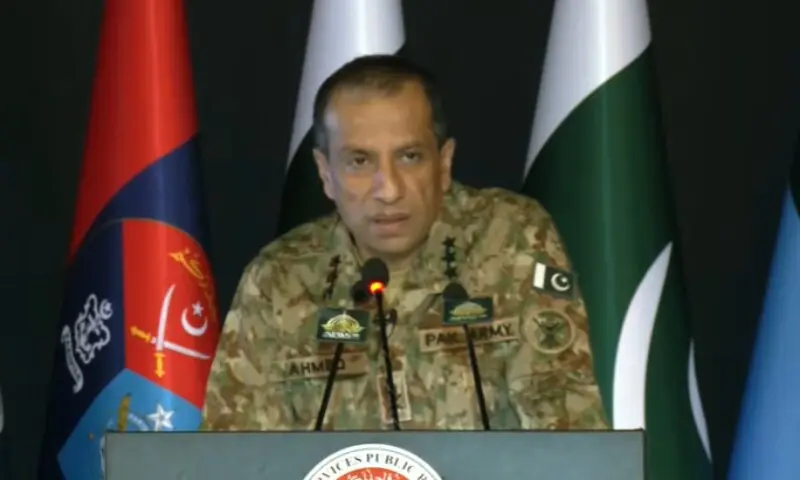
Good governance 'quintessential' for security and stability of Pakistan: DG ISPR
Why This Matters
Key context: <p>Inter-Services Public Relations (ISPR) Director General Lieutenant General Ahmed Sharif Chaudhry on Friday termed good governance “quintessential” for Pakistan’s security and stability.</p> <p>He made the remarks while addressing a press conference on the country’s overall security situation, particularly the situation in Balochistan.</p> <p>The DG ISPR, during his presser, commented on Interior Minister Mohsin Naqvi’s <a href="https://www.dawn.com/news/2019502">remarks </a>about the need for new administrative units in Pakistan: “We have been saying this earlier also as a primary stakeholder in security that good governance is essential for the security and stability of Pakistan.”</p> <p>Without this, he stressed that none of Pakistan’s issues could be resolved.</p> <p>The military spokesperson said the National Action Plan (NAP), with its 14-point agenda and the consensus of all political parties, required good governance for its implementation, adding, “Good governance is quintessential for Pakistan.”</p> <p>“Now, how to achieve good governance? The politicians and political parties have to decide. If you ask us, yes, there has to be a serious discussion on it.”</p> <p>“Now our population is 240-250 million people, and we still have four provinces. We have to see whether this is serving the purpose of good governance. That debate has to be sensibly held by politicians, by those in power, even those who have previously been in power, and those who are responsible to the people of Pakistan,” the DG ISPR said, adding that it had to be done according to the will of the people of Pakistan.</p> <p>“The will of the people of Pakistan is superior. If good governance requires an administrative reset, then it has to be done through constitutional methods, legal procedures and political representatives.”</p> <h2><a id="10-terrorists-killed-per-day-in-2026" href="#10-terrorists-killed-per-day-in-2026" class="heading-permalink" aria-hidden="true" title="Permalink"></a>10 terrorists killed per day in 2026</h2> <p>At the outset of the briefing, the military spokesperson said 40,348 intelligence-based operations had been conducted this year so far, adding that the figure included operations carried out by all security forces, including police, civil armed forces, intelligence agencies and the armed forces.</p> <p>Of these operations, the majority were carried out in Balochistan, with the number exceeding 31,000, he said.</p> <p>The DG ISPR added that a total of 3,145 terrorism incidents had taken place in the country in 2026, of which 1,971 were reported from Khyber Pakhtunkhwa, 1,148 from Balochistan and 26 from other parts of the country.</p> <p>During this period, he continued, 2,084 confirmed terrorists were killed. “This comes to an average of 10 terrorists being killed every day, which is the highest ratio ever,” he added.</p> <p>Meanwhile, security forces were undertaking nearly 200 intelligence-based operations (IBOs) a day. “So these IBOs are going on every hour.”</p> <p>The DG ISPR further stated that “819 Pakistanis have been martyred” in incidents of terrorism during the ongoing year, which amounted to four a day. This comprised 303 army personnel, 194 law enforcers, including police and civil armed forces personnel, and 322 civilians.</p> <p>He added that 28 suicide bombing incidents had taken place this year, “the majority of which were carried out by Afghan nationals […] and people associated with their security forces”.</p> <p>Comparing the figures for terrorists killed last year and in 2026, he said 2,597 were killed in 2025 and 2,084 this year so far.</p> <p>Pointing out that five months were left before 2026 would end, he said, “The way the kinetic prong of the counter-terrorism is maturing, responding and delivering, that is before you.”</p> <p>He further elaborated that the number of martyrs in comparison to slain terrorists was higher, but the tide started turning in 2024. And in 2025, “for each martyr we were taking out minimum two [terrorists], and this year, we are taking out minimum 2.5 [terrorists].”</p> <p>Here, he added, a valid question to ask would be why terrorism incidents were rising. “Because once returns from other elements of their strategy begin diminishing, they focus more here. And you saw when their direct strategy during Marka-i-Haq failed, they started investing a lot more here,” he explained.</p> <p>The DG ISPR added that this also had to do with the “agenda of the terrorist-supporting Taliban regime” and the clarity demonstrated by the state of Pakistan.</p> <p>“These terrorists and their sponsors have come to understand that there is no space for appeasement or any talks with them […] They know that the state is telling them very clearly that either you submit to the state’s will in accordance with the law and the Constitution, or we are here and fighting,” he said.</p> <p>Moreover, he added, this also had to do with the proactive nature of the operations. “These [terrorism] incidents also rise because when we get proactive […] there will be more engagements.”</p> <h2><a id="hard-state" href="#hard-state" class="heading-permalink" aria-hidden="true" title="Permalink"></a>‘Hard state?’</h2> <p>Speaking of the “perception that the situation in Balochistan has worsened”, he said the matter would be examined through three questions.</p> <p>The first question was what the issue was, the second was what was happening and the third was what was being done, he said.</p> <p>Coming to the first question, he said the issue was not specific to Balochistan alone but related to the overall security environment in Pakistan.</p> <p>The issue, he said, was “Hard state, question mark”.</p> <p>“Are we a hard state? Unfortunately, not,” the military’s spokesperson added. Explaining the reason behind his answer, he said a hard state was one where the Constitution and the law applied equally to everyone. “That is what a hard state is. It does not mean a military-run state; it does not mean an armed forces-dominated state,” he added.</p> <p>The DG ISPR said a state where all matters were decided in accordance with the Constitution and the law, where everyone was equal, was a hard state. In such a state, there would be security and stability, and there would be no grievances.</p> <p>Then there was also the matter of obligations versus rights, he said, adding that it pertained to being aware of one’s responsibilities before speaking about one’s rights.</p> <p>“We are all taking up grievances — at some places slogans are also being raised in connection with those grievances and even arms are being taken up in some instances — and all those grievances [pertain to demands for rights],” he said.</p> <p>Saying that the demands for rights and the grievances may be genuine, he added that obligations needed to be fulfilled first.</p> <p>“Let me try to explain the context constitutionally,” he said, quoting Article 5 of the Constitution.</p> <p>The provision came before Article 8, which elaborated on fundamental rights, he said, adding that Article 5 stated: “Loyalty to the state and obedience to the Constitution and law. It says loyalty to the state is the basic duty of every citizen. Full stop. Absolutely clear.”</p> <p>“The second part of the provision states that obedience to the Constitution and law is the inviolable obligation of every citizen wherever he may be.”</p> <p>So the Constitution was “clear that we have some fundamental duties, including the need to be loyal to the state”.</p> <p>“If we are loyal to the state and we are obedient to the Constitution and the law, then you can talk about your rights,” he said. Citing a statement by Chief of Defence Forces and Chief of Army Staff Field Marshal Asim Munir at the National Workshop in Balochistan recently, he said when the rights movement is talked about, why not an “obligations movement”.</p> <p>“There has to be a movement for the obligation of every citizen,” he asserted.</p> <p>Further speaking of the obligations, he said, “Is this not an obligation for every citizen that our first and final identity should be Pakistani? … We are citizens of this state, so our first identity and our last identity and the foremost identity is being a Pakistani.</p> <p>“It is our obligation to acknowledge the fundamental position, the central position of the state of Pakistan because if there is the state, there is politics, there is life […] These are our fundamental obligations.</p> <p>“Are we working towards that? Let’s think about it.”</p> <p>Focusing on Balochistan, he said the fundamental issues in the province were elitism, sardarism and the desire to maintain the status quo.</p> <p>“This is that part of society which believes it has no obligations and only thinks of its rights. The elites and the <em>sardars</em> are a part of it. And I am not talking about all of them, but those who believe that this status quo must be maintained,” the DG ISPR said.</p> <p>He added that this status quo predated 1947, under which a poor man’s child could not get an education or progress in life.</p> <p>Those who did not want the status quo to change were the “prime movers of terrorism because they are afraid that the times are changing”.</p> <p>Then there was the issue of the desire for appeasement, the DG ISPR said.</p> <p>“They carry out terrorism, they talk about terrorism and say that Balochistan is getting out of hand. Then they expect that we talk to them and appease them […] No, we will not. We will talk with the actual stakeholders, who are the people of Balochistan,” he added.</p> <p>“You are not the stakeholder. You are only a stakeholder in your own and your family’s fortunes.”</p> <p>The military’s spokesperson went on to say that the problem with such elements was that they were not being appeased. “They have this habit of thinking that the Levies force is their private force, their <em>sardari</em> force.”</p> <p>“So once you start turning Balochistan’s Levies into a police force, they have a problem.”</p> <p>He further said that these elements were involved in smuggling in the name of business. “And if you stop this, there is terrorism. They promote terrorism and say Balochistan is getting out of hand.”</p> <p>Moving on, the DG ISPR said a third issue was “external power play”.</p> <p>The “elitists and sardarists have a common agenda”, he said, adding that “external powers” realised that Balochistan was blessed not only with “a very vibrant and very progressive human resource” but also with natural resources.</p> <p>“It has a blue economy, agriculture. They know the potential of Balochistan. They realise that when Balochistan rises, the whole of Pakistan rises and the region rises. And they have a problem, so they get physically involved through these terrorists […] and they find ready partners in these elitists and sardarists,” he said.</p> <p>Moreover, there was the issue of “contiguous support bases”, especially from Afghanistan.</p> <p>He said the business of the Afghan Taliban regime was terrorism and that, through terrorism, it sustained its economy, state and even diplomacy.</p> <p>“Even their diplomacy is centred on terrorism. What is common between India and Afghanistan, except their DNA? The only thing common is terrorism,” he added.</p> <p>“What is common between <em>Fitna-al-Hindustan</em> and <em>Fitna-al-Khawarij</em>? Nothing. One is secular and nationalist, and the other is hardcore religious extremist. But because they are carrying out coordinated operations now…” he said.</p> <p>The government labelled the banned Tehreek-i-Taliban Pakistan as <em>Fitna-al-Khawarij</em> and <a href="https://www.dawn.com/news/1914525"><u>designated</u></a> Balochistan-based groups as <em>Fitna-al-Hindustan</em> to <a href="https://www.dawn.com/news/1912930#:~:text=The%20term%20%E2%80%98Fitna%20al%20Hindu%C2%ADstan%E2%80%99%20is%20a%20new%20phrase%20coined%20by%20Pakistan%E2%80%99s%20military%2C%20aimed%20at%20framing%20India%E2%80%99s%20alleged%20role%20in%20terrorism%20as%20a%20deliberate%20destabilisation%20strategy%2C%20potentially%20to%20galvanise%20domestic%20support."><u>highlight</u></a> India’s alleged role in terrorism and destabilisation across Pakistan.</p> <p>He further stated that propaganda was another issue, which, he said, had three strands: a sense of deprivation, lack of representation and missing persons.</p> <p>Sharing data on facilities in various areas of Balochistan, he said the province’s per capita budget was more than Rs75,000, which was higher than that of any other province.</p> <p>“Then on what basis is this narrative of a sense of deprivation in Balochistan spun? It is spun on actions to prevent development. That is why they kill labourers and attack roads, hospitals and bridges. Are these military targets?” the DG ISPR questioned.</p> <p>Coming to the issue of lack of representation, he said same people and their families were in the assemblies since 1973. “Most of them are the same <em>khanzaday</em> and <em>nawabzaday</em>. It’s the same religious parties and same names, and either they win or their family members win. If they win, it is democracy, but if they don’t win, [the narrative is] there is dictatorship.”</p> <p>On missing persons, he said the government had formed a commission to inquire into the matter. The DG ISPR added the commission had received just 10,901 applications since its formation in the early 2010s.</p> <p>Of those, 9,372 cases had been disposed of, he said, adding that in 4,896 of the disposed-of cases, missing people had returned home, around 1,030 were located in prisons, 308 were found dead and 2,400 cases were declared as misreported cases.</p> <p>Moreover, he said, 2,933 of the total cases were reported from Balochistan, among which 2, 767 had been disposed of.</p> <p>He went on to say persons reported missing in the remaining cases were often found among killed terrorists after operations.</p> <p>The DG ISPR added that terrorists were now also filming attacks to build a narrative that the situation in Balochistan was deteriorating.</p> <p>He further pointed out that Balochistan’s area was 347,190 sq km, which was more than the area of many countries, as he elaborated on the need for more security personnel. He said this while speaking about raising a new command of the Frontier Corps, FC West, and its attached units in the province.</p> <p>Sharing details of the current situation in Balochistan, he said terrorists had killed 178 civilians in the province this year, kidnapped 55 civilians, damaged roads and bridges at 24 places, set property on fire at 60 places and there were 47 incidents of looting.</p> <p>Police and Levies were targeted in 105 incidents, he said.</p> <p>They carry out terrorist activities, film it and release videos, and “elitists and <em>sardarists</em> start crying over the deteriorating situation”, he added. They target infrastructure and run this propaganda about a lack of development, the military’s spokesperson said, mentioning Indian involvement in such activities as well.</p> <p>Here, he also spoke about the challenges faced by police as first responders, again citing Balochistan’s vast area as well as capacity constraints.</p> <p>The DG ISPR further said that previous governments that let Levies be a “sardari force” were answerable in this regard. He questioned why the funds were not translated into equipment for police, adding, “Because you did not want to respond to your BLA pets.”</p> <p>He then lauded police for fighting against terrorism, asking why were they not being acknowledged. “Because terrorists are making videos […] that are used to create a narrative,” he answered.</p> <p>Moreover, he said terrorists were “honey-trapping” girls. They would kidnap and abuse them and then blackmail them into committing acts of terrorism.</p> <p>He also said that 300 Indian websites were being operated for terrorism-related activities in Balochistan, more than 1,000 social media accounts were being used for the purpose and that a “hostile diaspora” was also involved in propaganda related to terrorism.</p> <p>Explaining the social media ecosystem used by terrorists, the DG ISPR said: “First, an event or incident is seeded, right or wrong, and then it is framed by initiators, who hand it over to amplifiers. Then mass amplification is done by mainstream Indian media, channels and their print media as well, from where it is picked up by international media, and then you take it and run it as facts.”</p> <p>Citing the example of the July 16 attack on a convoy in Mastung, the military spokesperson said that accounts associated with BYC, BLA and political parties based abroad were involved in amplifying it.</p> <p>He further noted: “There is already an ecosystem here that whenever there is negative news about Pakistan, certain actors are always there to mark their attendance.”</p> <p>Speaking of kinetic operations against terrorists in Balochistan, he said currently security forces were conducting <a href="https://www.dawn.com/news/2015946">Operation Shaban</a>, which had been morphed into <a href="https://www.dawn.com/news/2018661">Operation Al-Azm.</a></p> <p>He also said that most of the operations were carried out jointly by the army, FC and police.</p> <p>Moreover, <a href="https://www.dawn.com/news/1976050/forces-repel-miscalculated-attacks-by-afghan-taliban">Operation Ghazab lil-Haq</a> was also under way against the Afghan Taliban.</p> <p>The military’s spokesperson said that 2.6 million Afghans had been repatriated to Afghanistan from Pakistan, of whom 600,000 were repatriated this year.</p> <p>The general also said that work was underway to strengthen the capacity of security forces in the province, including the establishment of FC West in Chagai, which he said would ensure the “security of the mineral corridor”.</p> <p>The DG ISPR added that the government was working on strengthening the police force as well, including the posting of newly recruited ASPs to Balochistan and the provision of bulletproof vehicles, among other measures.</p> <p>He also stressed the significance of “empowering and appeasing” the common people of Balochistan. “We are committed to engaging and talking directly with people,” he said.</p> <p>He added that Rs70 billion had been allocated to socioeconomic projects in Balochistan and Rs24bn for the Balochistan Special Development Initiative. He further stated that development projects aimed at improving road connectivity, IT training and human resources were also in progress.</p> <p>Concluding his address, the DG ISPR played a video of the government’s direct engagements with people in Balochistan.</p> <p>“This is the bright future of Balochistan that we need to further nurture, develop and propagate because Balochistan has a remarkable future,” he said.</p> <p>“In the words of the Field Marshal, and he says it with a lot of conviction, within 5-10 years it is going to be the richest province; it is going to be a game changer. And the bigger the potential, the bigger the threats we face, but we, the people of Pakistan and Balochistan, will overcome [them].”</p> <h2><a id="kashmir-jugular-vein-of-pakistan" href="#kashmir-jugular-vein-of-pakistan" class="heading-permalink" aria-hidden="true" title="Permalink"></a>‘Kashmir jugular vein of Pakistan’</h2> <p>On the <a href="https://www.dawn.com/news/2019021">unrest </a>in Azad Jammu and Kashmir (AJK), DG ISPR held, “Kashmir was, is and will remain a jugular vein of Pakistan.”</p> <p>“Only one voice is coming from Pakistan: Kashmir will be Pakistan, and there is only one voice coming from Kashmir: Pakistan is ours, we are Pakistani, nothing can change that.”</p> <p>Referring to the Joint Awami Action Committee’s (JAAC) protests, he said that “we knew who was behind that movement, but we wanted them to expose themselves. They have been exposed now”.</p> <p>He said that JAAC opposed refugee representation in AJK’s legislature; however, the state had asked them “wholeheartedly” to contest the elections and approach the matter legally and constitutionally.</p> <p>“However, they want to do this by force, but only the state has the monopoly of violence.”</p> This development from dawn.com highlights ongoing changes in the sector.
Inter-Services Public Relations (ISPR) Director General Lieutenant General Ahmed Sharif Chaudhry on Friday termed good governance “quintessential” for Pakistan’s security and stability. He made the remarks while addressing a press conference on the country’s overall security situation, particularly the situation in Balochistan. The DG ISPR, during his presser, commented on Interior Minister Mohsin Naqvi’s remarks about the need for new administrative units in Pakistan: “We have been saying this earlier also as a primary stakeholder in security that good governance is essential for the security and stability of Pakistan.” Without this, he stressed that none of Pakistan’s issues could be resolved. The military spokesperson said the National Action Plan (NAP), with its 14-point agenda and the consensus of all political parties, required good governance for its implementation, adding, “Good governance is quintessential for Pakistan.” “Now, how to achieve good governance? The politicians and political parties have to decide. If you ask us, yes, there has to be a serious discussion on it.” “Now our population is 240-250 million people, and we still have four provinces. We have to see whether this is serving the purpose of good governance. That debate has to be sensibly held by politicians, by those in power, even those who have previously been in power, and those who are responsible to the people of Pakistan,” the DG ISPR said, adding that it had to be done according to the will of the people of Pakistan. “The will of the people of Pakistan is superior. If good governance requires an administrative reset, then it has to be done through constitutional methods, legal procedures and political representatives.” 10 terrorists killed per day in 2026 At the outset of the briefing, the military spokesperson said 40,348 intelligence-based operations had been conducted this year so far, adding that the figure included operations carried out by all security forces, including police, civil armed forces, intelligence agencies and the armed forces. Of these operations, the majority were carried out in Balochistan, with the number exceeding 31,000, he said. The DG ISPR added that a total of 3,145 terrorism incidents had taken place in the country in 2026, of which 1,971 were reported from Khyber Pakhtunkhwa, 1,148 from Balochistan and 26 from other parts of the country. During this period, he continued, 2,084 confirmed terrorists were killed. “This comes to an average of 10 terrorists being killed every day, which is the highest ratio ever,” he added. Meanwhile, security forces were undertaking nearly 200 intelligence-based operations (IBOs) a day. “So these IBOs are going on every hour.” The DG ISPR further stated that “819 Pakistanis have been martyred” in incidents of terrorism during the ongoing year, which amounted to four a day. This comprised 303 army personnel, 194 law enforcers, including police and civil armed forces personnel, and 322 civilians. He added that 28 suicide bombing incidents had taken place this year, “the majority of which were carried out by Afghan nationals […] and people associated with their security forces”. Comparing the figures for terrorists killed last year and in 2026, he said 2,597 were killed in 2025 and 2,084 this year so far. Pointing out that five months were left before 2026 would end, he said, “The way the kinetic prong of the counter-terrorism is maturing, responding and delivering, that is before you.” He further elaborated that the number of martyrs in comparison to slain terrorists was higher, but the tide started turning in 2024. And in 2025, “for each martyr we were taking out minimum two [terrorists], and this year, we are taking out minimum 2.5 [terrorists].” Here, he added, a valid question to ask would be why terrorism incidents were rising. “Because once returns from other elements of their strategy begin diminishing, they focus more here. And you saw when their direct strategy during Marka-i-Haq failed, they started investing a lot more here,” he explained. The DG ISPR added that this also had to do with the “agenda of the terrorist-supporting Taliban regime” and the clarity demonstrated by the state of Pakistan. “These terrorists and their sponsors have come to understand that there is no space for appeasement or any talks with them […] They know that the state is telling them very clearly that either you submit to the state’s will in accordance with the law and the Constitution, or we are here and fighting,” he said. Moreover, he added, this also had to do with the proactive nature of the operations. “These [terrorism] incidents also rise because when we get proactive […] there will be more engagements.” ‘Hard state?’ Speaking of the “perception that the situation in Balochistan has worsened”, he said the matter would be examined through three questions. The first question was what the issue was, the second was what was happening and the third was what was being done, he said. Coming to the first question, he said the issue was not specific to Balochistan alone but related to the overall security environment in Pakistan. The issue, he said, was “Hard state, question mark”. “Are we a hard state? Unfortunately, not,” the military’s spokesperson added. Explaining the reason behind his answer, he said a hard state was one where the Constitution and the law applied equally to everyone. “That is what a hard state is. It does not mean a military-run state; it does not mean an armed forces-dominated state,” he added. The DG ISPR said a state where all matters were decided in accordance with the Constitution and the law, where everyone was equal, was a hard state. In such a state, there would be security and stability, and there would be no grievances. Then there was also the matter of obligations versus rights, he said, adding that it pertained to being aware of one’s responsibilities before speaking about one’s rights. “We are all taking up grievances — at some places slogans are also being raised in connection with those grievances and even arms are being taken up in some instances — and all those grievances [pertain to demands for rights],” he said. Saying that the demands for rights and the grievances may be genuine, he added that obligations needed to be fulfilled first. “Let me try to explain the context constitutionally,” he said, quoting Article 5 of the Constitution. The provision came before Article 8, which elaborated on fundamental rights, he said, adding that Article 5 stated: “Loyalty to the state and obedience to the Constitution and law. It says loyalty to the state is the basic duty of every citizen. Full stop. Absolutely clear.” “The second part of the provision states that obedience to the Constitution and law is the inviolable obligation of every citizen wherever he may be.” So the Constitution was “clear that we have some fundamental duties, including the need to be loyal to the state”. “If we are loyal to the state and we are obedient to the Constitution and the law, then you can talk about your rights,” he said. Citing a statement by Chief of Defence Forces and Chief of Army Staff Field Marshal Asim Munir at the National Workshop in Balochistan recently, he said when the rights movement is talked about, why not an “obligations movement”. “There has to be a movement for the obligation of every citizen,” he asserted. Further speaking of the obligations, he said, “Is this not an obligation for every citizen that our first and final identity should be Pakistani? … We are citizens of this state, so our first identity and our last identity and the foremost identity is being a Pakistani. “It is our obligation to acknowledge the fundamental position, the central position of the state of Pakistan because if there is the state, there is politics, there is life […] These are our fundamental obligations. “Are we working towards that? Let’s think about it.” Focusing on Balochistan, he said the fundamental issues in the province were elitism, sardarism and the desire to maintain the status quo. “This is that part of society which believes it has no obligations and only thinks of its rights. The elites and the sardars are a part of it. And I am not talking about all of them, but those who believe that this status quo must be maintained,” the DG ISPR said. He added that this status quo predated 1947, under which a poor man’s child could not get an education or progress in life. Those who did not want the status quo to change were the “prime movers of terrorism because they are afraid that the times are changing”. Then there was the issue of the desire for appeasement, the DG ISPR said. “They carry out terrorism, they talk about terrorism and say that Balochistan is getting out of hand. Then they expect that we talk to them and appease them […] No, we will not. We will talk with the actual stakeholders, who are the people of Balochistan,” he added. “You are not the stakeholder. You are only a stakeholder in your own and your family’s fortunes.” The military’s spokesperson went on to say that the problem with such elements was that they were not being appeased. “They have this habit of thinking that the Levies force is their private force, their sardari force.” “So once you start turning Balochistan’s Levies into a police force, they have a problem.” He further said that these elements were involved in smuggling in the name of business. “And if you stop this, there is terrorism. They promote terrorism and say Balochistan is getting out of hand.” Moving on, the DG ISPR said a third issue was “external power play”. The “elitists and sardarists have a common agenda”, he said, adding that “external powers” realised that Balochistan was blessed not only with “a very vibrant and very progressive human resource” but also with natural resources. “It has a blue economy, agriculture. They know the potential of Balochistan. They realise that when Balochistan rises, the whole of Pakistan rises and the region rises. And they have a problem, so they get physically involved through these terrorists […] and they find ready partners in these elitists and sardarists,” he said. Moreover, there was the issue of “contiguous support bases”, especially from Afghanistan. He said the business of the Afghan Taliban regime was terrorism and that, through terrorism, it sustained its economy, state and even diplomacy. “Even their diplomacy is centred on terrorism. What is common between India and Afghanistan, except their DNA? The only thing common is terrorism,” he added. “What is common between Fitna-al-Hindustan and Fitna-al-Khawarij? Nothing. One is secular and nationalist, and the other is hardcore religious extremist. But because they are carrying out coordinated operations now…” he said. The government labelled the banned Tehreek-i-Taliban Pakistan as Fitna-al-Khawarij and designated Balochistan-based groups as Fitna-al-Hindustan to highlight India’s alleged role in terrorism and destabilisation across Pakistan. He further stated that propaganda was another issue, which, he said, had three strands: a sense of deprivation, lack of representation and missing persons. Sharing data on facilities in various areas of Balochistan, he said the province’s per capita budget was more than Rs75,000, which was higher than that of any other province. “Then on what basis is this narrative of a sense of deprivation in Balochistan spun? It is spun on actions to prevent development. That is why they kill labourers and attack roads, hospitals and bridges. Are these military targets?” the DG ISPR questioned. Coming to the issue of lack of representation, he said same people and their families were in the assemblies since 1973. “Most of them are the same khanzaday and nawabzaday. It’s the same religious parties and same names, and either they win or their family members win. If they win, it is democracy, but if they don’t win, [the narrative is] there is dictatorship.” On missing persons, he said the government had formed a commission to inquire into the matter. The DG ISPR added the commission had received just 10,901 applications since its formation in the early 2010s. Of those, 9,372 cases had been disposed of, he said, adding that in 4,896 of the disposed-of cases, missing people had returned home, around 1,030 were located in prisons, 308 were found dead and 2,400 cases were declared as misreported cases. Moreover, he said, 2,933 of the total cases were reported from Balochistan, among which 2, 767 had been disposed of. He went on to say persons reported missing in the remaining cases were often found among killed terrorists after operations. The DG ISPR added that terrorists were now also filming attacks to build a narrative that the situation in Balochistan was deteriorating. He further pointed out that Balochistan’s area was 347,190 sq km, which was more than the area of many countries, as he elaborated on the need for more security personnel. He said this while speaking about raising a new command of the Frontier Corps, FC West, and its attached units in the province. Sharing details of the current situation in Balochistan, he said terrorists had killed 178 civilians in the province this year, kidnapped 55 civilians, damaged roads and bridges at 24 places, set property on fire at 60 places and there were 47 incidents of looting. Police and Levies were targeted in 105 incidents, he said. They carry out terrorist activities, film it and release videos, and “elitists and sardarists start crying over the deteriorating situation”, he added. They target infrastructure and run this propaganda about a lack of development, the military’s spokesperson said, mentioning Indian involvement in such activities as well. Here, he also spoke about the challenges faced by police as first responders, again citing Balochistan’s vast area as well as capacity constraints. The DG ISPR further said that previous governments that let Levies be a “sardari force” were answerable in this regard. He questioned why the funds were not translated into equipment for police, adding, “Because you did not want to respond to your BLA pets.” He then lauded police for fighting against terrorism, asking why were they not being acknowledged. “Because terrorists are making videos […] that are used to create a narrative,” he answered. Moreover, he said terrorists were “honey-trapping” girls. They would kidnap and abuse them and then blackmail them into committing acts of terrorism. He also said that 300 Indian websites were being operated for terrorism-related activities in Balochistan, more than 1,000 social media accounts were being used for the purpose and that a “hostile diaspora” was also involved in propaganda related to terrorism. Explaining the social media ecosystem used by terrorists, the DG ISPR said: “First, an event or incident is seeded, right or wrong, and then it is framed by initiators, who hand it over to amplifiers. Then mass amplification is done by mainstream Indian media, channels and their print media as well, from where it is picked up by international media, and then you take it and run it as facts.” Citing the example of the July 16 attack on a convoy in Mastung, the military spokesperson said that accounts associated with BYC, BLA and political parties based abroad were involved in amplifying it. He further noted: “There is already an ecosystem here that whenever there is negative news about Pakistan, certain actors are always there to mark their attendance.” Speaking of kinetic operations against terrorists in Balochistan, he said currently security forces were conducting Operation Shaban, which had been morphed into Operation Al-Azm. He also said that most of the operations were carried out jointly by the army, FC and police. Moreover, Operation Ghazab lil-Haq was also under way against the Afghan Taliban. The military’s spokesperson said that 2.6 million Afghans had been repatriated to Afghanistan from Pakistan, of whom 600,000 were repatriated this year. The general also said that work was underway to strengthen the capacity of security forces in the province, including the establishment of FC West in Chagai, which he said would ensure the “security of the mineral corridor”. The DG ISPR added that the government was working on strengthening the police force as well, including the posting of newly recruited ASPs to Balochistan and the provision of bulletproof vehicles, among other measures. He also stressed the significance of “empowering and appeasing” the common people of Balochistan. “We are committed to engaging and talking directly with people,” he said. He added that Rs70 billion had been allocated to socioeconomic projects in Balochistan and Rs24bn for the Balochistan Special Development Initiative. He further stated that development projects aimed at improving road connectivity, IT training and human resources were also in progress. Concluding his address, the DG ISPR played a video of the government’s direct engagements with people in Balochistan. “This is the bright future of Balochistan that we need to further nurture, develop and propagate because Balochistan has a remarkable future,” he said. “In the words of the Field Marshal, and he says it with a lot of conviction, within 5-10 years it is going to be the richest province; it is going to be a game changer. And the bigger the potential, the bigger the threats we face, but we, the people of Pakistan and Balochistan, will overcome [them].” ‘Kashmir jugular vein of Pakistan’ On the unrest in Azad Jammu and Kashmir (AJK), DG ISPR held, “Kashmir was, is and will remain a jugular vein of Pakistan.” “Only one voice is coming from Pakistan: Kashmir will be Pakistan, and there is only one voice coming from Kashmir: Pakistan is ours, we are Pakistani, nothing can change that.” Referring to the Joint Awami Action Committee’s (JAAC) protests, he said that “we knew who was behind that movement, but we wanted them to expose themselves. They have been exposed now”. He said that JAAC opposed refugee representation in AJK’s legislature; however, the state had asked them “wholeheartedly” to contest the elections and approach the matter legally and constitutionally. “However, they want to do this by force, but only the state has the monopoly of violence.”
Curation & Context
This page summarizes a public news report from dawn.com. Global News Hub provides the "Why This Matters" takeaway using editorial insights and AI curation to give readers rapid, high-value context before they click through to read the full article.