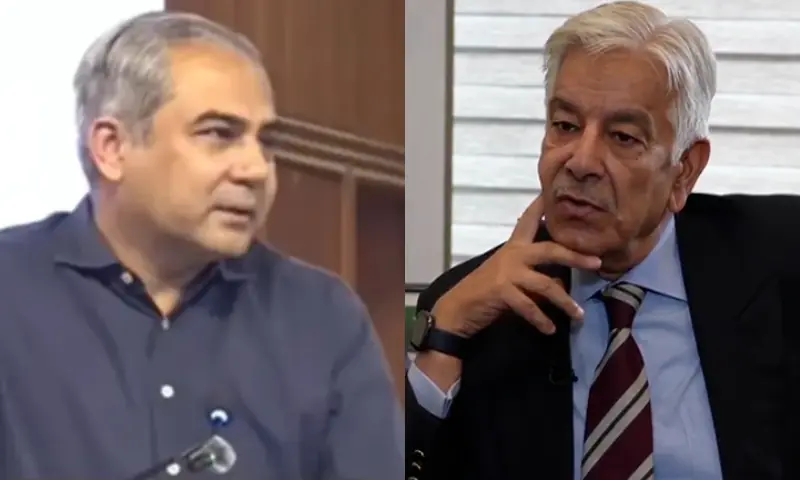
Asif reacts to Naqvi's call for governance reset, urges him to begin with his own ministry
Why This Matters
Key context: <p>Reacting to Interior Minister Mohsin Naqvi’s <a href="https://www.dawn.com/news/2019599">call</a> for an overhaul of the country’s governance structure, Defence Minister Khawaja Asif has advised him to initiate the change by implementing the National Action Plan (NAP) and with his own ministry.</p> <p>Speaking at the Pakistan Economic Summit on Thursday, Naqvi had said the governance system in the country had “collapsed” and argued that the country needed new administrative units, or provinces, to improve service delivery, accountability and access to justice. He had also said new leadership was needed in the country and argued that the youth wanted justice, merit and jobs rather than stipends and laptops.</p> <p>A day later, the military’s spokesperson also <a href="https://www.dawn.com/news/2019826/military-throws-its-weight-behind-call-for-governance-reset">urged</a> political parties to consider an administrative reset for improving governance, arguing that the country’s security and stability depended on adapting its governance structure to the requirements of modern times and a growing population.</p> <p>Speaking at a news conference, Inter-Services Public Relations Director General Lt Gen Ahmed Sharif Chaudhry said governance had long been identified by the military as a prerequisite for national security. Further recalling the NAP adopted after the 2014 Army Public School attack, he said its 14-point agenda, unanimously endorsed by political parties, had also rested on effective governance.</p> <p>On Saturday, Asif reacted to Naqvi’s suggestion in an X post, in which he also mentioned the DG ISPR’s remarks.</p> <p>“Mohsin Naqvi’s <em>sahib</em> expressed his views on the dire state of the system. I more or less personally agree with these views,” he said, calling the interior minister a “powerhouse”.</p> <p>Asif added that as a political worker, he too strongly felt the process of the system’s evolution had been “held captive to factional and personal interests for decades, and it needs to be freed”.</p> <p>He said he had a few requests in this regard, adding: “If the system has to be strengthened and a fundamental change has to be brought about, its forum is Parliament, of which Naqvi <em>sahib</em> is a member. Or this matter could be discussed in the cabinet.</p> <p>“This way, these institutions and the system would strengthen, and the change would be brought about through a constitutional process.”</p> <p>Asif went on to point out Naqvi was also a member of the cabinet, further claiming that he rarely attended parliamentary and cabinet sessions.</p> <figure class='media w-full w-full media-- media--embed media--uneven media--tweet' data-original-src='https://x.com/KhawajaMAsif/status/2083603618746499330'> <div class='media__item media__item--twitter '><span> <blockquote class="twitter-tweet" lang="en"> <a href="https://twitter.com/KhawajaMAsif/status/2083603618746499330"></a> </blockquote> </span></div> </figure> <p>He said: “In my opinion, [treating] these institutions as irrelevant and making such a big statement to a captive audience after inviting the country’s eminent and respected businessmen doesn’t carry the same weight that speaking at the relevant constitutional forums would have earned.”</p> <p>Asif said Naqvi had been on a “very powerful post” of the system for the past three years. “Had he wanted, he could have spoken about a change in the system or made progress on it during this time,” he said, moving to cite the DG ISPR’s remarks during Friday’s press briefing.</p> <p>The defence minister said the military’s spokesperson had referred to the NAP.</p> <p>“The implementation of one of its points, which is the armed forces’ responsibility, is being done by sacrificing lives. The implementation of the remaining 12 points is the interior ministry’s responsibility, but they have not been implemented.</p> <p>“Mohsin Naqvi <em>sahib</em>, begin the change in the system with the implementation of NAP; begin the change in the system with your ministry. Not just the respected business community, the entire nation is with you,” he added.</p> <p>Naqvi’s <a href="https://www.dawn.com/news/2019825">call</a> for a reset of the system and creation of more administrative units has sparked a debate in the country, with the PPP referring the question to its top decision-making forum, the Sindh chief minister flatly rejecting it, Lahore’s lawyers terming it unconstitutional and Sindhi nationalist groups demanding the minister’s resignation.</p> <p>In the recent past, the Muttahida Qaumi Movement-Pakistan (MQM-P) — also an ally of the PML-N-led ruling coalition — has repeatedly <a href="https://www.dawn.com/news/1974999"><u>demanded</u></a> that Karachi be designated a province separate from Sindh. However, the PPP, which rules Sindh and is also an ally of the PML-N government at the Centre along with MQM-P, has <a href="https://www.dawn.com/news/1974798/integral-inseparable-part-of-province-sindh-assembly-passes-resolution-against-creation-of-karachi-province"><u>strongly opposed</u></a> the suggested move.</p> This development from dawn.com highlights ongoing changes in the sector.
Reacting to Interior Minister Mohsin Naqvi’s call for an overhaul of the country’s governance structure, Defence Minister Khawaja Asif has advised him to initiate the change by implementing the National Action Plan (NAP) and with his own ministry. Speaking at the Pakistan Economic Summit on Thursday, Naqvi had said the governance system in the country had “collapsed” and argued that the country needed new administrative units, or provinces, to improve service delivery, accountability and access to justice. He had also said new leadership was needed in the country and argued that the youth wanted justice, merit and jobs rather than stipends and laptops. A day later, the military’s spokesperson also urged political parties to consider an administrative reset for improving governance, arguing that the country’s security and stability depended on adapting its governance structure to the requirements of modern times and a growing population. Speaking at a news conference, Inter-Services Public Relations Director General Lt Gen Ahmed Sharif Chaudhry said governance had long been identified by the military as a prerequisite for national security. Further recalling the NAP adopted after the 2014 Army Public School attack, he said its 14-point agenda, unanimously endorsed by political parties, had also rested on effective governance. On Saturday, Asif reacted to Naqvi’s suggestion in an X post, in which he also mentioned the DG ISPR’s remarks. “Mohsin Naqvi’s sahib expressed his views on the dire state of the system. I more or less personally agree with these views,” he said, calling the interior minister a “powerhouse”. Asif added that as a political worker, he too strongly felt the process of the system’s evolution had been “held captive to factional and personal interests for decades, and it needs to be freed”. He said he had a few requests in this regard, adding: “If the system has to be strengthened and a fundamental change has to be brought about, its forum is Parliament, of which Naqvi sahib is a member. Or this matter could be discussed in the cabinet. “This way, these institutions and the system would strengthen, and the change would be brought about through a constitutional process.” Asif went on to point out Naqvi was also a member of the cabinet, further claiming that he rarely attended parliamentary and cabinet sessions. He said: “In my opinion, [treating] these institutions as irrelevant and making such a big statement to a captive audience after inviting the country’s eminent and respected businessmen doesn’t carry the same weight that speaking at the relevant constitutional forums would have earned.” Asif said Naqvi had been on a “very powerful post” of the system for the past three years. “Had he wanted, he could have spoken about a change in the system or made progress on it during this time,” he said, moving to cite the DG ISPR’s remarks during Friday’s press briefing. The defence minister said the military’s spokesperson had referred to the NAP. “The implementation of one of its points, which is the armed forces’ responsibility, is being done by sacrificing lives. The implementation of the remaining 12 points is the interior ministry’s responsibility, but they have not been implemented. “Mohsin Naqvi sahib, begin the change in the system with the implementation of NAP; begin the change in the system with your ministry. Not just the respected business community, the entire nation is with you,” he added. Naqvi’s call for a reset of the system and creation of more administrative units has sparked a debate in the country, with the PPP referring the question to its top decision-making forum, the Sindh chief minister flatly rejecting it, Lahore’s lawyers terming it unconstitutional and Sindhi nationalist groups demanding the minister’s resignation. In the recent past, the Muttahida Qaumi Movement-Pakistan (MQM-P) — also an ally of the PML-N-led ruling coalition — has repeatedly demanded that Karachi be designated a province separate from Sindh. However, the PPP, which rules Sindh and is also an ally of the PML-N government at the Centre along with MQM-P, has strongly opposed the suggested move.
Curation & Context
This page summarizes a public news report from dawn.com. Global News Hub provides the "Why This Matters" takeaway using editorial insights and AI curation to give readers rapid, high-value context before they click through to read the full article.